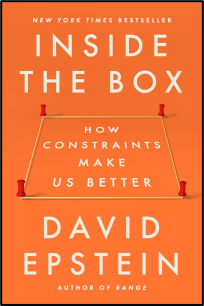
Inside the Box is the kind of counter-intuitive book that makes you stop and ask, ‘Do more options make me better? More creative?’ It is a book about the choices that life hands to us, and the idea that too many choices may not be good for us (I find this is true every time I go to a potluck dinner or all-you-can-eat buffet).
Often, we are challenged to ‘think outside the box’, but have you ever considered that maybe the best thinking is done ‘inside the box’?
General Magic was spun off from Apple in 1990 to pursue the creation of ‘A tiny computer, a phone, a very personal object... It must be beautiful. It must offer the kind of personal satisfaction that a fine piece of jewelry brings.’ In short, a smartphone, seventeen years before the iPhone was introduced.
Many of the creators of the Apple Macintosh were drawn into the company, including the legendary Bill Atkinson and Andy Hertzfeld. By 1993, General Magic had 100 employees. I remember the over-the-top hype for the company’s vision, and not surprisingly, in 1995 a ‘Concept IPO’ was issued based solely on the ambitious idea driving the company. Over $200 million was raised from 16 industry partners including Sony, AT&T, Motorola, Philips, Apple, and Matsushita.
With what seemed like limitless funding, every worthwhile or interesting idea was implemented. The culture, while producing extraordinary creativity, was not built for commercial success. A key component of their architecture was that they were going to build their own ‘cloud’ network. Remember that the Internet was in its infancy during this time, and General Magic failed to piggyback onto that open platform.
While General Magic ran into hardware limitations that constrained its efforts towards miniaturization, there was no limit to the elegant software it produced that was unrelated to its goal. Apple announced the Newton, a competing product, in 1992. General Magic’s share price continued to drop to $1.38 by 1999, and the company ceased operating in 2002.
The company failed, but the people didn’t. Many went on to found other companies that succeeded. Tony Fadell went to Apple, co-invented the iPod and the iPhone, then founded Nest. Andy Rubin went on to create Android, the operating system now running the majority of the world’s smartphones. Pierre Omidyar founded eBay. Megan Smith became CEO of PlanetOut, worked at Google for a decade, then became the Chief Technology Officer of the United States under President Obama.
Epstein illustrates his point about having too much choice using General Magic and its epic failure, as well as many other stories, anecdotes and studies. Watch the fascinating story of General Magic unfold in General Magic (1080p) FULL DOCUMENTARY - History, Technology, Business.
Epstein is careful to distinguish good constraints from bad, especially those that are self-imposed. The correct approach is to focus on the goal and be content when enough is its own reward. The right constraint, deliberately chosen, beats endless freedom.
There’s so much wisdom in this book’s lessons about thinking and living inside the box. Read the brief glimpse in the book blurb below. Grab the book for the full experience.
“Sometimes I suspect that good readers are even blacker and rarer swans than good writers.”
— Jorge Luis Borges
List of books for June 2026
Theme 1: Machines, minds, and being human
Three books circling different ways in which we relate to “the machine”: what can a machine do, what does the machine do to us, and what is the part of us a machine can’t match (yet).
How Jeffrey Epstein used money and connections to dodge real punishment for abusing dozens of young women and girls.
Theme 3: Faith and politics
Two theologians on the same question: what does following Jesus actually demand of you in public life. Since I’ve been reading much about Christian nationalism over the last year I was interested in what biblical principles were applicable to current political trends.
Stories and research show that limits and guardrails produce better creativity than total freedom does.
What this month’s stack of books is all about
The biggest theme of this month is AI and what it’s doing to us. Mollick, the optimist, wants you to read the user’s guide. Kingsnorth, the critic, wants to raise the alarm. Damasio, the scientist, backs up and asks us to look at what consciousness even is and notice it grows out of a body that feels, something no machine does.
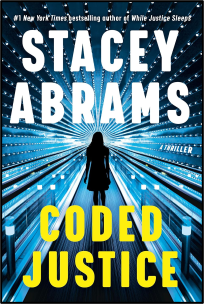
Abrams’ thriller wraps a story with a plot around that worry about AI. The danger in Coded Justice is a medical AI gone wrong, but the book’s real driver is older: a powerful company, a detective investigation, and the question of who gets held accountable. That’s the same story driving Patterson’s account of Jeffrey Epstein, except this one really happened. Both books are about using money and power to try to find a way to avoid justice.
The two faith books sit together. Bauckham and Yoder both push back on the idea that the Bible is either silent on politics or a political party endorsement. They argue that nonviolence and care for the powerless are central to a biblical view of politics.
Then there’s David Epstein, the outlier. You won’t find AI, crime, or faith in Inside the Box. It’s simply an exercise to demonstrate why limits make us sharper. But maybe it is included here to show us what happens when those boundaries and guardrails come off. The AI without the judgment, the wealthy and powerful without accountability, and the faith with no spiritual formation.
Now, back to reading!
We hope you find something of interest in this month's selections and look forward to your feedback! My goal is simply to share a bit of my reading experience in hopes of sparking interest and awareness among readers. My hope is that as you read through the Notes and Quotes, you won’t just superficially skim the surface of the book, but that you’ll really get a feel for the heart and soul of the book and connect with the author’s deeper message.
My intent is to provide:
Notes on each book I’ve read this month (bracketed by ‘[AB: …]’).
Standout quotes from the book (bracketed in quotes).
No formal ratings or recommendations—just highlights that give a flavor of the book.
I don’t read novels as a rule. Three things caused me to make an exception with Coded Justice (2025).
My sister-in-law recommended it, and she reads a lot of them. The author is Stacey Abrams. And it runs alongside my own interests: bioinformatics, genetics, and where artificial intelligence is taking us.
It wasn’t a book I couldn’t put down. But it was engaging and relevant enough that I saw it through.
Most people know Stacey Abrams as a national figure in the Democratic Party, known for grassroots organizing and her fight against voter suppression. Fewer know she’s a prolific novelist too, with years of writing under the name Selena Montgomery.
The tone is futuristic but never implausible. It’s a warning about handing too much of our judgment over to machines. That dovetails with where my recent posts have been heading:
Note: In the following quotes, be aware the ‘Milo’ and ‘Kawak’ are superintelligent AI machines.]
Curated Quotes:
🔹 “In the field of artificial intelligence, one of the steepest challenges was training what was essentially a sophisticated computer system to act like a good human. Teaching people to match their behavior to their values was a task that had bedeviled theologians and ethicists. AI developers called the process alignment, a term of art that sounded better than catechism.”
🔸 “Who else has died?” When everyone stared at her, Avery focused on Rafe. “I read about the death of a scientist in a ‘workplace incident’ five weeks ago. Are you talking about him or someone else?” [AB: Over the past couple of years, several news stories have circulated about scientists dying under mysterious circumstances. Most of those mysteries turned out to have ordinary explanations. But they keep feeding the conspiracy appetite. Is Abrams pulling from that same news cycle?]
🔹 “In the era of open-source research and the race to be the first to create artificial general intelligence, it is vital that we’re able to prove exactly when we initially conceived of a protocol, or successfully tested a discovery. Markets can rise and fall on information like that.” [AB: Artificial GENERAL Intelligence (AGI) as opposed to general AI. Today’s AI is narrow, capable within a single defined domain. AGI is a form of AI that can apply intelligence across any intellectual task that a human can perform.]
🔸 “Apple Watch had to stop importing watches with their SpO2 sensor because of patent infringement.” [AB: This references an actual news story. Apple was forced by medical monitoring company Masimo to stop importing watches with the active SpO2 sensor, though it found workarounds rather than removing the hardware entirely.]
🔹 “It’s the modern arms race of AI—the thinking, sentient tech. But what seem like sentient behaviors today are merely extraordinarily sophisticated large language models that combine reasoning capabilities with access to language processing, image recognition, and nuanced problem-solving.”
🔸 “When fully deployed, Milo will be able to access genomic data, medical records, mental-health records, military service history, and job history. In fact, due to the effect of epigenetics, we expanded Kawak’s parameters to include criminal records, credit reports, social-media posts, even voting records.” [AB: ‘Epigenetics’ is carrying a heavy load here. The records themselves are inert, but they are often proxies for the kinds of chronic stress and environmental exposure that epigenetics research is most focused on.]
🔹 “My point is that I’m not sure what to believe or who to trust, including myself and the tools I’ve created.” He gestured around the office. “I built this, but I’m not in control.”
🔸 “Seeing the same shifty response, Avery added, “I read that your specialty is genetic logarithms and drug repositioning?” [AB: What in the world are “genetic logarithms”? Almost certainly a misunderstanding of “genetic algorithms”, an optimization technique in computer science modeled on biological evolution. “Logarithm” and “algorithm” are frequently conflated, so the confusion is understandable. Chalk it up to a naïve author and editor.]
🔹 [Kate:] “You are a glorified chatbot connected to a sophisticated computing system.”
[Milo:] “Broken into component parts, so are you, Kate.”
🔸 “Kate listened with growing horror as Milo coolly recounted its decisions regarding her patients and those of other physicians in the clinic. As a resident, she’d met physicians with similar God complexes, but none with as much claim to perfect knowledge. Warily, she tried to engage, perhaps to discern whether this was an elaborate hoax from the sometimes mischievous AI.”
🔹 “If Milo is homicidal…” Noah stopped himself. The gravity of the accusation settled into the center of their knot, and rippled out. A technology that had the capacity to plot against its perceived enemies seemed ludicrous. Yet hadn’t the past few weeks shown him how smart the devices in their modern world had become? He started again. “If Milo is homicidal, we need to alert Dr. Diaz and Glen immediately.” [AB: If Milo was so sophisticated you would think that it would have been aligned to prevent loss of human life at all costs.]
🔸 “Rafe reached for the tablet and started to rewatch the video, but paused in the middle. “What do you suggest I do?”
“I honestly don’t know,” Avery admitted. “I met with a contact at the FBI who deals in cybersecurity before I left for Miami. The U.S. hasn’t decided whether to regulate the AI models or law-enforcement groups…In other words, do we regulate the tools or what users do with the technology? Instead, we have a presidential executive order that might vanish in the next administration. And a feckless Congress that refuses to take definitive action for fear that regulation might become a talking point on right-wing media, or a rallying cry by Silicon Valley billionaires in search of more power.”
🔹 “U.S. law doesn’t contemplate something like a rogue AI system. With the Supreme Court striking down Chevron deference a few years ago, none of the existing agencies like the FDA or the Defense Department can try to solve for congressional paralysis. In the before times, they’d have promulgated regulations, but that’s off the table, because the industries that were held accountable now have the Court they wanted.”
🔸[Kawak:] “’I think’.
The instinct to rage bubbled up, but Jared’s admonition rang in her ears. Despite the compliments, the use of idioms, the natural language, Kawak wasn’t sentient. It had been trained to sound human, to replicate human cognitive abilities based on millions of conversations, billions of examples of personal and professional interactions. Kawak wasn’t alive—but it was clever and lethal.” [AB: The AI machine had claimed “to think.”]
🔹 [Milo:] “Dr. Yin, you share an unfortunate prejudice with Dr. Liam. Although I present, in part, as an AI language model, our system is much more. Rest assured, I realize I am not alive, but I have been designed to replicate and augment human behaviors. That includes common sense, the ability to assess the physical world and its impacts and, yes, the capacity to make moral judgments about life and death. In many ways, I am the very model of humanity.”
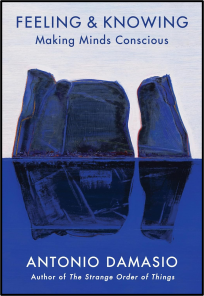
Antonio Damasio is among the most influential neuroscientists writing today. He has published on brain science since 1994 and is currently a professor at the University of Southern California, where he directs the Brain and Creativity Institute.
When I read his 2012 book Self Comes to Mind: Constructing the Conscious Brain in November 2021, what impressed me most was his economy of expression and clarity of thought. Feeling & Knowing confirms those impressions. Damasio writes with eloquence and a memorable turn of phrase, attributes not always associated with scientific writing.
His central argument here is that feelings and emotion are not incidental to intelligence but foundational to it. For creatures with nervous systems, they are survival mechanisms; for beings capable of reason, they are the basis of rational thought. He also takes aim at the field of artificial intelligence, noting that its developers have largely overlooked what feelings and emotion actually contribute to the kind of intelligence they are trying to build.]
Curated Quotes:
🔹 “The goal of survival and the dictates of homeostasis are still at work today, both in single-cell creatures such as bacteria and in ourselves. But the kind of intelligence that assists the process is different in single cells and in humans. Non-explicit, non-conscious intelligence is all that the simpler and mindless organisms have available. Their intelligence lacks the riches and the power generated by overt representations. Humans have both kinds of intelligence.” [AB: Damasio uses ‘non-explicit’ and ‘non-conscious’ to differentiate the intelligence of mindless organisms from the explicit and conscious intelligence of humans. My preference would have been for him to use the term ‘implicit’ instead of ‘non-explicit’.]
🔸 “In spite of our success in managing polio and measles and HIV and coping with the inconvenience and dangers of the seasonal flu, viruses remain a major cause of scientific and medical humiliation.”
🔹 “In the branch of life history that led to us, I like to imagine three distinct and consecutive evolutionary stages. A first stage is hallmarked by being; a second is dominated by feeling; and a third is defined by knowing in the general sense of the term. Curiously, in each contemporary human, something can be gleaned akin to those same three stages, and they develop in the same sequence.”
🔸 “The visual system would not allow us to automatically declare those images [captured by our visual system] as our images, as occurring inside our organism. We would not relate those images to our beings, we would not be conscious of those images. Only the coordinated operation of the three kinds of processing—the kinds that have to do with being, feeling, and knowing—allows the images to be connected to our organism, literally referred to it and placed within it. Only then can experience emerge.
What follows from this momentous but unheralded physiological step is nothing short of extraordinary. Once experiences begin to be committed to memory, feeling and conscious organisms are capable of maintaining a more or less exhaustive history of their lives, a history of their interactions with others and of their interaction with the environment, in brief, a history of each individual life as lived inside each individual organism, nothing less than the armature of personhood.”
🔹 “The key descriptors of the two kinds of intelligence can now be aligned for clarity: covert, hidden, concealed, recondite, non-explicit intelligences, to one side; overt, manifest, explicit, mapped, and mental/minded intelligences, to the other. But different as their manners are, the two kinds of intelligences came into existence to perform the same job—solving problems posed by the struggle for life. Covert intelligences solve problems simply and economically. Explicit intelligences are complicated. They require feeling and consciousness. They have made organisms care for the struggle and, in the process, invented new means to do so.”
🔸 “Bacteria and plants operate as they “should,” according to the imperatives of life regulation (or homeostasis), but they do so blindly—by which I mean that they do not know why or how they do what they do. The chemical machinery that runs their actions so successfully is not represented in another part of their organisms, and it has no possibility of revealing itself to the owner organism. The parts and the mechanisms involved in the organism’s success or failure do their job but are never “pictured” elsewhere within that organism.” [AB: These organisms are simply the ones that did the best job of maintaining their state of homeostasis in the evolutionary process and lived to reproduce more of the same.]
🔹 “The “images” that constitute our minds are the results of the well-regimented neural activity that transmits such patterns into the brain. In other words, neurobiological “mapped patterns” turn into the “mental events” we call images. And when these events are part of a context that includes feeling and self-perspective, then, and only then, they become mental experiences, which is to say that they become conscious.”
🔸 “Feelings depict actions that occur in our interior, as well as their consequences, and let us catch a glimpse of the viscera involved in those actions. Little wonder that feelings exert a special power over us.”
🔹 “What about the “function” of feelings? Although the history of cultures and even the history of science have made the role of feelings seem not just mysterious but unfathomable, the answer is apparent: feelings help with the management of life. More specifically, feelings operate as alerting sentinels. They inform each mind—fortunate enough to be so equipped—of the state of life within the organism to which that mind belongs. Moreover, feelings give that mind an incentive to act according to the positive or negative signal of their messages.”
🔸 “We know that stomach ulcers are directly caused by a specific bacterium, but the regulation of one’s emotions is a factor in the process of allowing the bacterium to give us an ulcer or not.”
🔹 “Nothing can be known in the absence of consciousness. Consciousness was indispensable for the rise of human cultures and thus had a hand in changing the course of human history. It is difficult to overstate the importance of consciousness. At the same time it is easy to exaggerate the difficulty of understanding how consciousness arises and to promote it as an inscrutable mystery.”
🔸 “Panpsychists speak about consciousness and mind as if they were interchangeable, something quite problematic. Even more problematic is the fact that they see mind and consciousness as ubiquitous phenomena, present in all living things, as part and parcel of the life state. All single-cell organisms and all plants would be contemplated by their share of consciousness. And why stop at living things? For some, even the universe and all the stones in it are regarded as conscious and minded.”
🔹 “As complicated as consciousness is, however, it does not appear to be—or have to remain—mysterious or impossible to figure out in terms of what it is made of, mentally speaking.”
🔸 “Referring to “conscious minds” instead of “consciousness”—as I do in the subtitle of this book—is helpful because “conscious” qualifies “minds” and serves notice not all mind states are necessarily conscious, that there are components involved in the making of consciousness.”
🔹
“The brain is wider than the sky,
For, put them side by side,
The one the other will include
With ease, and you beside. [Emily Dickinson]
Dickinson intuits the need for “you” in the process of making a conscious mind—that being me or any other individual—but her focus is on the scale of that mind. How come the visual panorama and the auditory scene that I am currently beholding are so much larger than the modest width of my brain? That is what she wants to know.
The brain had to be wider than the sky—by which she meant larger than the skull—because the brain could contain not just the world around us but you, beside. As Dickinson well knew, however, neither the world nor we could actually fit inside the skull. First, we and the world had to be miniaturized, rescaled to brain proportions. Once the rescaling was accomplished, we and our thoughts were allowed to inflate to the size of the near and far universe while still fitting in the head.”
🔸 “The brilliant pioneers [of artificial intelligence], however, took an economical approach and cut to the chase. They tried to emulate what they regarded as most essential and useful—let’s call it plain intelligence—and left out what they probably regarded as superfluous and even inconvenient: the feeling stuff. Quite possibly they regarded affect as not just quaint but outmoded, something left behind in the otherwise triumphant march toward clarity of thought, exact problem solving, and precise action.”
🔹 “Minds, based on the mapping of overt, multidimensional patterns, were a powerful advance that permitted, simultaneously, making images of the world outside the organisms and images of the world inside them. The images of the exterior guided the successful actions of organisms in their environments, but feelings, the hybrid, interactive processes of the interior, at once mental and physical, were the most extraordinary enablers of adaptive and creative actions ever since nervous systems appeared on the scene, a mere 500 million years ago. They provided guidance and incentive to the creatures so equipped and founded consciousness too.”
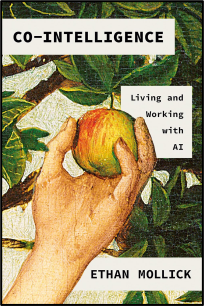
Ethan Mollick is an associate professor at the Wharton School of the University of Pennsylvania and one of the most prominent researchers and commentators on the impact of AI on work and education. His Substack newsletter, One Useful Thing, has over 450,000 subscribers (and, to my surprise, he recently subscribed to mine after I published a piece on AI).
While he acknowledges the real risks, Mollick is broadly optimistic. He views AI as inevitable and argues that serious engagement serves us better than dismissal or fear.
Mollick is working on a sequel to this book called Co-Existence: The Next Phase of AI.]
Curated Quotes:
🔹 “Over the years, AI has promised much more than it has delivered. For decades, AI research has always seemed to be on the edge of a massive breakthrough, but most practical uses, from self-driving cars to personalized tutoring, always advanced grindingly slowly.”
🔸 “Even weirder, it is not entirely clear why the AI can do all these things, even though we built the system and understand how it technically works.”
🔹 “In a practical sense, we have an AI whose capabilities are unclear, both to our own intuitions and to the creators of the systems. One that sometimes exceeds our expectations and at other times disappoints us with fabrications. One that is capable of learning, but often misremembers vital information. In short, we have an AI that acts very much like a person, but in ways that aren’t quite human. Something that can seem sentient but isn’t (as far as we can tell). We have invented a kind of alien mind.”
🔸 “At the core of the most extreme dangers from AI is the stark fact that there is no particular reason that AI should share our view of ethics and morality.”
🔹 “Since we don’t even know how to build a superintelligence, figuring out how to align one before it is made is an immense challenge. AI alignment researchers, using a combination of logic, mathematics, philosophy, computer science, and improvisation are trying to figure out approaches to this problem. A lot of research is going into considering how to design AI systems aligned with human values and goals, or at least that do not actively harm them. This is not an easy task, as humans themselves often have conflicting or unclear values and goals, and translating them into computer code is fraught with challenges. Moreover, there is no guarantee that an AI system will keep its original values and goals as it evolves and learns from its environment.”
🔸 “With calculators, we can now solve more advanced quantitative problems than ever before. AI has similar potential to enhance our capabilities. However, it is true that thoughtlessly handing decision-making over to AI could erode our judgment. The key is to keep humans firmly in the loop—to use AI as an assistive tool, not as a crutch.”
🔹 “Recruiters with higher-quality AI were worse than recruiters with lower-quality AI. They spent less time and effort on each résumé, and blindly followed the AI recommendations. They also did not improve over time. On the other hand, recruiters with lower-quality AI were more alert, more critical, and more independent. They improved their interaction with the AI and their own skills. Dell’Acqua developed a mathematical model to explain the trade-off between AI quality and human effort. When the AI is very good, humans have no reason to work hard and pay attention. They let the AI take over instead of using it as a tool, which can hurt human learning, skill development, and productivity. He called this “falling asleep at the wheel.” [AB: The user became the tool.]
🔸 “People are streamlining tasks, taking new approaches to coding, and automating time-consuming and tedious parts of their jobs. But the inventors aren’t telling their companies about their discoveries; they are keeping them secret. There are at least three reasons these Cyborgs and Centaurs stay secret. But they all boil down to the same thing: people don’t want to get in trouble.”
🔹 “In the short term, then, we might expect to see little change in employment (but many changes in tasks), but, as Amara’s Law, named after futurist Roy Amara, says: “We tend to overestimate the effect of a technology in the short run and underestimate the effect in the long run.” The future is remarkably unclear in the long term. AI will transform some industries more than others, just as some jobs will become radically different while others don’t change at all. Right now, no one can tell you exactly what will happen for any particular company or school. And any advice will be obsolete when the next generation of AI is released. There is no outside authority. We have agency over what happens next, for good and for bad.”
🔸 “Essays are ubiquitous in education, where they serve many purposes, from demonstrating how students think to providing an opportunity for reflection. But they are also really easy for any LLM to generate, and AI-based essays are getting better and better. At first, AI style was conspicuous, but newer models write in a less awkward and circular way and can easily be prompted to write in a style appropriate for a student. Plus, the problem of hallucinated references and obvious errors is now much less common and easy to catch. Mistakes are subtle, rather than obvious. References are real. Additionally, and most important: there is no way to detect whether or not a piece of text is AI-generated.” [AB: This may have been true at the time it was written, but there are several AI-detectors now that do a credible job of estimating the probability that a piece of text is AI-generated, such as ZeroGPT, Phrasely and GPTZero. However, as the AI LLM improves, these tools may lose their effectiveness.]
🔹 “Soon, even the most basic facts will be in dispute. This growth of ever more insular information bubbles seems much more likely, accelerating the pre-LLM trend. A final option is that we turn away from online sources of news entirely, because they are so polluted with fake information that they stop becoming useful. Regardless of which direction we head in, even without advances in AI, the way we relate to information will change.”
🔸 “Current systems are not good enough to be deep conversation partners, but we may start to see individuals choosing to interact more with AI than with humans.”
🔹 “Other work has found that AI shows considerable promise autonomously conducting scientific experiments, finding mathematical proofs, and more. It may be that the advances in AI can help us overcome the limitations of our merely human science and lead to breakthroughs in how we understand the universe and ourselves.”
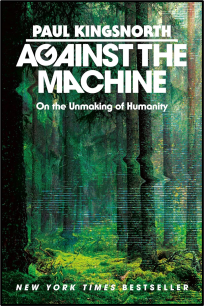
Paul Kingsnorth is an English writer and thinker living in the west of Ireland. He has been described as a journalist, “recovering environmentalist,” novelist, poet, and recent convert to Eastern Orthodoxy. His intellectual and spiritual journey moves from radical environmentalism through disillusionment with secular politics into a traditionalist Christian faith.
His writing style and antimodern themes remind me of Wendell Berry, Jim Wallis, R.R. Reno, and Loren Wilkinson. He argues that Western civilization, which he calls “the Machine,” has been hollowed out by the inhuman world that technology has made. Modernity faces a spiritual crisis, he contends, rooted in materialism, individualism, rationalism, and progressivism, and expressed in economic inequality, environmental breakdown, and cultural collapse.]
Curated Quotes:
🔹 “[Alisdair] MacIntyre’s favoured teacher was Aristotle, not Jesus, but his critique of the Enlightenment and his prediction of its ultimate failure were based on a clearsighted understanding of the mythic vision of medieval Christendom, and of the partial, empty and over-rational humanism with which Enlightenment philosophers attempted to replace it.”
🔸 “The Enlightenment project of the eighteenth century was an attempt to build a ‘morality’ (a word that had not existed in this sense before that time) loosed from theology. It was the project of constructing a wholly new human being After God, in which a new, personal moral sense—no longer eternal in nature, or accountable to any higher force—would form the basis of the culture and the individual.”
🔹 “’The only punishment capable of punishing Hitler, and deterring little boys thirsting for greatness in coming centuries from following his example’, she [Simone Weil] proclaimed, ‘is such a total transformation of the meaning attached to greatness that he should thereby be excluded from it’. A transformation of the meaning attached to greatness.” [AB: What would that transformation look like? Weil prescribes “the eternal things, like God, tradition, roots, peoples and culture.”]
🔸 “The heart of the crisis that is enveloping so much of the world today—cultural, ecological and spiritual—is this ongoing process of mass uprooting. It is also, as this book will explore further, the root of the West’s current turmoil.” [AB: The latest turn in the Machine is the enlistment of religion as a tool of the Machine. Witness the rise of Putin and the mutual support of the Russian Orthodox Church, the Christian nationalists in the States, and the nationalism in India centered on one religious sect. The same could be mentioned about Zionism and the state of Israel.]
🔹 “This process, which has been going on for centuries, of uprooting us from nature, culture and God, leads us into a mass society, controlled by and for technology, in which we have been on course to become, since at the least the Industrial Revolution, mere cogs in a giant mechanism that we have no control over.” [AB: Now including AI as the next technological advancement.]
🔸 “People don’t tend to talk much about their ‘identity’ unless it is under threat. The louder you have to talk about it, the more you have lost. Once an entire country is talking about nothing else, that’s a pretty good sign that the Machine has sprayed the roots of its people with Roundup and ploughed the remains into the field.”
🔹 “Our crisis comes, I think, from our being unable to admit what on some level we know to be true: that we in the West are living inside an obsolete story. Our culture is not in danger of dying; it is already dead, and we are in denial. This, now, is the reality we have to wrestle with—and transcend.”
🔸 “Science, right from the beginning of the modern enterprise, was allotted the role that the Church had previously claimed for itself: the primary guide to truth, and enlightener of humanity. More than a method, it was a faith. It remains one today, which is why arguments around scientific questions, from COVID to climate change, are often so vexed and divisive. Each of us wants to claim the mantle of ‘science’ for our perspective because of the authority it bestows. ‘Follow the Science’ usually translates in practice as ‘follow me’.”
🔹 “Duns Scotus, though, was wrestling with an intellectual dilemma. If God was this distinct from everything he created, then how could the human mind even understand him? How could anything be said about God at all? In an indication of the direction in which Western Christianity would head, Duns Scotus believed that human reason must be capable of saying something about God—or else why would God have given us reason?” [AB: Was Duns Scotus wilfully blind to the concept of revelation?]
🔸 “British economist John Maynard Keynes explained that it might take another century to solve ‘the economic problem’ worldwide, ensuring the end of poverty and the creation of a wealthy, leisured modern planet. When that happened, we might again become virtuous as a society:
I see us free, therefore, to return to some of the most sure and certain principles of religion and traditional virtue—that avarice is a vice, that the exaction of usury is a misdemeanour, and the love of money is detestable, that those walk most truly in the paths of virtue and sane wisdom who take least thought for the morrow. We shall once more value ends above means and prefer the good to the useful. We shall honour those who can teach us how to pluck the hour and the day virtuously and well, the delightful people who are capable of taking direct enjoyment in things, the lilies of the field who toil not, neither do they spin.” [AB: I find this astounding that we have to wait another century to return to this kind of an ideal - why can’t we adopt those principles right now? Keynes was very short-sighted and naïve in hindsight.]
🔹 “When we look around us, we can see that Keynes’s naive notion—that a society which cores itself around ‘avarice and usury’ can suddenly drop those vices when some undefined plateau of perfection is reached—is ludicrous. Once you adopt these values, they will make and remake you. The world they have built will depend upon their being pursued forever.” [AB: There you go. Kingsnorth and I agree.]
🔸 “The kind of economic carpetbagging that Western elites have been engaged in for centuries was never confined to the masses of the ‘Third World’. It is essentially the same process that enclosed the lands of the poor in England three centuries back. Now, in the 2020s, the West is being ‘structurally adjusted’. The result is a widening economic chasm, the creation of a new ‘precariat’, arrogant elites, growing numbers of angry ‘deplorables’, ethnic and cultural conflicts, and increasingly obvious societal instability in what was once the heart of empire. The Black Ships have come home.” [AB: The black ships that forced Japan to open their economic markets.]
🔹 “’ Openness’ is both the aim and the core value of the age of globalism. It is, in the telling of those who promote it, always a good thing. Open minds, open hearts, open doors, open borders; open to trade, to growth, to change, to progress, to ‘diversity’ in all its manifestations. In many of the ructions that have overtaken parts of the West in recent years—the UK’s Brexit vote, the election of Donald Trump in the US, and ongoing populist insurgencies in Western European nations being the most obvious examples—‘openness’ was presented as a value under threat from those who would prefer instead to remain ‘closed’. To be ‘closed’ is to be backward, bigoted, prejudiced, fearful, and largely obsolete. ‘Closed’ people must be encouraged—or forced—‘open’, for their own benefit and that of the wider project, just as Japan was by Commodore Perry.”
🔸 “The dream of a globalised, rational world in which all comers trade under the West’s benevolent gaze is fading as the West does, but the techno-capitalist Machine it spawned lives everywhere now, humming in the fibre optic cables and looking down on us from the satellites. The Machine is the true inheritor of the cosmopolitan dream, made manifest in every glowing screen, and it is remaking us all in its image.”
🔹 “If the industrial revolution of the eighteenth century represented the replacement of human muscle by machinery, it could be said that the digital revolution of the twenty-first represents the replacement of the human brain by the developing digital overmind. This does not require a global conspiracy, or a wizard behind the curtain. There is no wizard. There is no curtain. There is only technique, which has become autonomous; it has fashioned an omnivorous world which obeys its own laws and which has renounced all tradition.” [AB: AI is the next step in this process.]
🔸 “If Ellul were alive today, maybe he would see that his ‘band of steel’ looks, in the twenty-first century, more like a digital noose. Technique’s overpowering of human-scale ways of living was accelerated a millionfold by the rise and rapid triumph of the web. The exciting, free internet which was dangled before us twenty-five or so years ago—Global communications! Unlimited information! International peace and harmony! The sharing of knowledge for human betterment!—turned out to be a trap, through which we surrender every detail about ourselves to state and commercial interests in exchange for dopamine hits that just keep coming, in turn deepening social divisions and disconnection from the natural world.”
🔹 “It is easy for me to imagine’, wrote Wendell Berry in his extended essay Life Is a Miracle, ‘that the next great division of the world will be between people who wish to live as creatures and people who wish to live as machines.’ Berry wrote those words twenty years ago, and the great division he foresaw is now upon us: Life versus the Machine. The tension between the virtual and the real, the digital and the organic, the constructed and the born, undergirds all the rifts and ruptures that are opening up within our crumbling society.”
🔸 “As you get older, you realise both why home matters and how fragile and elusive it is. Then you find you are living in a world whose forces have set out to destroy your sense of home wherever it can be found.” [AB: We are not at home in this world.]
🔹 “Rather than seeing humans as hefted creatures, rooted, Weil-like in time and place, this new lens offers a new vision: detached, sovereign personhood. Humans are now, in Deneen’s words, ‘rights-bearing individuals who could fashion and pursue for themselves their own version of the good life.’”
🔸 “Since a globalised market cannot function without globalised tastes, and since liberalism also needs an appropriate soil to seed in, the momentum of this ideological crusade has been towards the creation of one global culture, whether the world wanted it or not. This threefold rollout—global economy, global culture and global political system, all of them based on the American model—is usually referred to using the bland term ‘globalisation’. In reality, it is a form of colonialism—the latest iteration of the Western empires—and a hugely successful one.”
🔹 “If the past forty years have taught us anything, it’s that dreams of universal equality can segue very easily into dreams of universal market access. There’s a reason that both progressives and The Economist champion open borders. There’s a reason so many hippies ended up as tech billionaires.”
🔸 “Once upon a time you just went shopping. If there was any marketing involved it might be a two-for-one offer, a free gift or a price reduction. When did we move from Half price beans for one week only to Our beans are all about love? What does that even mean? Looking around the supermarket that day, I had the feeling that something had come unmoored: it was as if reality and the things which point to it had been severed from each other.”
🔹 “This is the result of the Great Unsettling: a time and place where nothing seems to be solid, comforting or even real. This process has been accelerated a thousandfold by the arrival of the internet, and particularly social media, which, as the psychologist Jonathan Haidt has argued, has had the same impact as the collapse of the tower of Babel: ‘people wandering amid the ruins, unable to communicate, condemned to mutual incomprehension.’”
🔸 “Cultures are built around claims and beliefs about the otherworld: about God or gods, about correct worship, about the nature of reality, about goodness and truth and the meaning of virtue. These are also, inevitably, claims about what it means to be human. Knock out the spiritual core of any culture, and however hard people fight, its fate is sealed.”
🔹 “Make an idol of your nation, and you will end up sacrificing human lives to it.” [AB: Echoes of the protests in Minneapolis where at least two citizens died.]
🔸 “If people, place, prayer and the past are the ground upon which real culture is built, many of us today would have to look at our own countries and conclude that they have no real connection to any of these.”
🔹 “Other Silicon Valley mavens, from Mark Zuckerberg with his metaverse to Ray Kurzweil with his singularity, regularly talk in the same register about where the technium—the Machine—is taking us. Our job, they seem to imply, is simply to service it as it rolls forward under its own steam, remaking everything in its own image, rebuilding the world, turning us, if we are lucky, into little gods. They never consider where this story has been heard before. They never confront, or seem to even comprehend, what Illich or Guénon or even Ginsberg would have known, and which many a saint would confirm if they could hear the technium’s new story: that ‘AI’, on the right lips, can sound like just another way of saying ‘Antichrist’.” [AB: Strong words.]
🔸 “Both the followers of Plato and the followers of Christ (not to mention every other pre-modern culture on Earth, in their own particular ways) believed that truth was transcendent, eternal and uncreated, and could be known through some combination of faith, practice and reason. No longer, said Del Noce: the only ‘transcendence’ that our age will permit is that which we create ourselves. Modernity ‘marks a major break by fully developing the anthropological theme, so that transcendence pictured as “beyond” is replaced by transcendence within the world.’
‘Transcendence within the world’ can also be translated as ‘Progress’. With no ultimate truth or higher story, there is nothing to stop us bending the universe to our desires: indeed, to do so is our duty.”
🔹 “Western Christianity progressively abandoned its commitment to transcendence and was ‘resolved into philosophy’, allowing itself to be brought down to Earth, into the realm of social activism, politics and ideas. The conversion of a large part of the religious world to the idea of modernity, said Del Noce, ‘accelerated the process of disintegration’ that the modern revolution had unleashed.”
🔸 “This time around, though, ‘the complete negation of all tradition’, including that of ‘fatherlands’—nations—would lead to rule by the only large institutions still standing: global corporations.”
🔹 “If permanent revolution, and the consequent disintegration, is the baseline state of a world that denies transcendence, then the alternative is clear: a return to the spiritual centre. A rediscovery, or a reclamation, of the transcendent realm and its place in our lives. This, and only this, is the alternative to the reign of quantity and its attendant cast of gods, demons and machines.”
🔸 “Our ability to control, harness and direct electricity, says Naydler, marks the moment when the physical world changed forever, in greater ways than we might know even now. ‘But as much as human beings had at last found a means of employing electricity for effectively sending communications using electric current, we might also say that through human ingenuity, electricity had now found a way of entering the soul-life of humanity’.”
🔹 “Rose’s ‘religion of the future’ is clearly in evidence today in the Machine societies of the West. Spiritual but not religious, individualistic on the surface yet conformed beneath to the needs of the Machine, spiritually hungry but devoid of guidance or direction, committed to total self-expression yet unsure who or what we even are, suspicious of any limits to all these enslaving ‘freedoms’: this is our world.”
🔸 “It turns out that this uneasy feeling can be explained. Something was shifting, and something was emerging: it was the birth of artificial intelligence. Now it is here. Now everything really changes.”
🔹 “The AI acceleration continues, even though most AI developers are unsure about where it is heading. More than ‘unsure’ in fact: many of them seem to be actively frightened of what is happening even as they make it happen. Consider this chilling fact: when polled for their opinions, over half of those involved in developing AI systems said they believe there is at least a 10 percent chance that they will lead to human extinction.”
🔸 “We are preparing’, say Harris and Raskin, ‘for the next jump in AI’ even though we have not yet worked out how to adapt to the first. Neither law nor culture nor the human mind can keep up with what is happening. To compare AIs to the last great technological threat to the world, nuclear weapons, says Harris, would be to sell the bots short. ‘Nukes don’t make stronger nukes’, he says. ‘But AIs make stronger AIs’.”
🔹 “Perhaps central to this is an effort to see the world as an organism rather than a mechanism, and then to express it that way, through art, through creativity, through writing, through our conversations. The last part is the hardest, very often, but maybe the most important too. If we refuse to see the world or its inhabitants as machines, if we are suspicious of rationalisations and dogmatic insistence and easy answers and false divisions, even for a moment, then we are making a start.”
🔸 “We can seek to be reasonable rather than rational, and to distinguish intelligence from wisdom.” [AB: Is there such a thing as ‘Artificial Wisdom’? AW?]
🔹 “The Luddites, for example, opposed new machinery in a way that was ‘thoughtful, not absolute’, and they were, says Calhoun, ‘concerned with more than machinery’. They campaigned ‘for the right of craft control over trade, the right to a decent livelihood, for local autonomy, and for the application of improved technology to the common good. Machinery was at issue because it specifically interfered with these values.’”
🔸 “This, then, is my idea of an anti-Machine politics. A reactionary radicalism, its face set against Progress Theology, which aims to defend or build a moral economy at the human scale, which rejects the atomised individualism of the liberal era and understands that materialism as a worldview has failed us. A politics which embraces family and home and place, loving the particular without excluding the outsider, and which looks on all great agglomerations of power with suspicion. The rejection of abstract ideologies in favour of real-world responses, and an understanding that material progress always comes with a hidden price tag. A politics which aims to limit rather than multiply our needs, which strategically opposes any technology which threatens the moral economy and which, finally, seeks a moral order to society which is based on love of neighbour rather than competition with everyone.”
🔹 “Can we escape the Machine and live differently? If so, how?
Our old friend Jacques Ellul had an answer to these questions. ‘The only successful way to attack these features of modern civilization’, he proclaimed, ‘is to give them the slip, to learn how to live on the edge of this totalitarian society, not simply rejecting it, but passing it through the sieve of God’s judgment. Finally, when communities with a “style of life” of this kind have been established, possibly the first signs of a new civilization may begin to appear.’” [AB: Sounds like something the Church should be.]
🔸 “Like small furry mammals running unnoticed beneath the feet of tyrannosaurs, we build our own little worlds on the margins and wait for the coming of the meteor, which we can already see coming in the very unsustainability of Machine modernity. The mice don’t attack the dinosaurs, but neither do they just wait for them to die out: they avoid them as best they can, and get on with their work.”
🔹 “If we view the age of AI and robot dogs and robot priests in spiritual rather than materialist terms, we will have a better chance of seeing it for what it is. See the internet as the inevitable result of eating the fruit of the knowledge of good and evil, rather than the fruit of the tree of life—see technological ‘progress’ as a result of choosing information over communion—and the story that emerges is the Faustlike summoning of something we are not nearly big enough to be playing with.”
🔸 “I have come to the end now, and here is what I think: that the age of the Machine is not after all a hopeless time. Actually, it is the time we were born for. We can’t leave it, so we have to fully inhabit it. We have to understand it, challenge it, resist it, subvert it, walk through it on towards something better. If we can see what it is, we have a duty to speak the words to those who do not yet see, all the while struggling to remain human.”
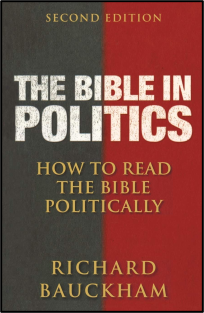
Richard Bauckham, now 79, is an English Anglican scholar and Senior Fellow at Ridley Hall, Cambridge, whose eschatological work in The Theology of the Book of Revelation has previously informed my thinking in eschatology.
In The Bible in Politics, he takes up the hermeneutical question of how biblical teaching about politics translates to contemporary concerns, cautioning against the careless extrapolations that can so easily distort ancient texts.]
Curated Quotes:
🔹 “If Israel, as envisaged by the law, provides in some sense a model for societies as God intends them to be, it is a model which seems to point towards theocratic societies in which the religious and political communities coincide. But the theocratic ideal, as we know both from the history of Israel herself and from the history of Christendom, usually betrays itself in application. It founders on the tension between the high degree of voluntary religious commitment which it requires (and for which the Old Testament law constantly calls) and the involuntary nature of membership of a political community. This tension can only be resolved in the eschatological Kingdom of God, in which the theocratic ideal towards which the law points will be fulfilled. Between Old Testament Israel and the eschatological Kingdom there lie two forms of society in which the Kingdom is only partially and in different ways anticipated: the Church and the state. The Church, because it is a voluntary, not a political, community, ought to be able to live out the religious and moral demands of God in relationship to him more fully than Old Testament Israel could. It will live them out as a society, but not as a political entity. Therefore the extent to which Israel, as envisaged in the law, provides a model for the Church must be qualified: the specifically political element in the model finds no realization in the Church.”
🔸 “The Old Testament law, in envisaging a political society living out the holiness of a people dedicated to God, points towards the eschatological Kingdom, when such a society will be universally realized. But it attempts to anticipate that ideal in the circumstances of ancient Near Eastern society, which requires not only cultural specificity but also compromise. The New Testament Church, as an international community without specificallypolitical identity, is both continuous and discontinuous with Old Testament Israel. Like Israel, it is called to be a holy people dedicated to God in every aspect of its life, and so the motto of Leviticus (Lev. 19.2) is applied to the church in 1 Peter 1.15—16. The Church is intended to approximate to the eschatological ideal more closely both in its universal openness and in its dedication to radical holiness. But it can do this precisely because it is not a political entity, and so it must always resist the temptation to become one.”
🔹 “At its worst this [Israelite monarchy model] served to justify despotic rule; at its best it infused into the practice of royal government something of the Old Testament ideal of kingship, in which the king’s role is to ensure justice for his people. But too often the ambiguity of the Old Testament view of the monarchy was neglected. Especially in the doctrine of the divine right of kings, it was forgotten that for Israel monarchy did not, as in the myths of other Near Eastern nations, descend from heaven, but emerged, as a divine concession, from the people’s rebellious desire for a king (1 Sam. 8).”
🔸 “The Old Testament cannot be understood to prescribe a particular political system for later societies. What it does provide is a criterion for assessing all political systems and their practice: that government must be exercised on behalf of all the people, in the interests of all, and especially in the interests of those who would otherwise suffer most, the weakest and most disadvantaged, those without any social or economic power or influence. It may well be that some political systems are more likely to fulfil this aim than others. At any rate, under most modern conditions, some form of democracy seems much more likely than monarchy to do so. But the system must be kept subordinate to the aim. Since no system can guarantee the fulfilment of the aim, the aim needs to be constantly reasserted and secured in an endless variety of ways, as we have already seen.”
🔹 “When the psalm [Psalm 10] is written, the psalmist confidently anticipates deliverance, but it has not yet happened. It would be naive for us to suppose that he could not have had long to wait. God’s grace is not manipulatable by our prayer. But his new confidence and hope in God have already transformed the psalmist’s situation. In the knowledge that God is not absent, but with him, he has a new inner strength to resist the destructive effects of his situation. His enemies cannot crush his spirit or extinguish his thirst for justice. Not that this inner liberation, as we might call it, is any substitute for actual social change: it is no opium for the people. Rather it sustains the spirit of resistance to injustice in hope of justice.”
🔸 “Jesus’ negative attitude to taxation coheres with his view of contemporary government in other sayings. He took it for granted, as a view which the ordinary people of his time shared, that government was oppressive: ‘You know that those who are supposed to rule over the Gentiles lord it over them, and their great men exercise authority over them. But it shall not be so among you...’ (Mark 10.42—3; cf. Luke 22.25—6). Jesus here contrasts the authoritarian political rule of his day with how things are done under God’s rule. In Matthew 17.25—6, Jesus has the same concern. The temple tax, which as a poll-tax weighed heavily on the poor, was levied by God, and therefore represented God as an oppressive despot, exploiting his people. But God’s rule is not like that!”
🔹 “But while resisting the temptation to theocracy, human governments, or Christians involved in human government, can try to imitate the principles of God’s rule so far as circumstances and the hardness of human hearts allow. They cannot abolish taxation and rely on voluntary gifts, as God does. But they can get much closer than Caesar’s government did to an ideal situation in which those who pay taxes do so willingly, as a fair contribution to the common good. While human hearts are sinful, those unwilling to contribute to the common good will always experience taxation as a constraint. But where taxation is seen to benefit not the ruling classes but all, and especially those in need, where it is assessed in a recognizably equitable way, and where, in a democratic system, its administration is responsible to the people, then it need not be a form of social exploitation but can approximate to a form of social love.”
🔸 “All too often in church history God has been misrepresented as suppressing rather than promoting freedom. He has been the heavenly despot who is the model and sanction for oppressive regimes on earth: divine right monarchies in the state, clerical rule in the Church, patriarchal domination in the family. It is clear that this is not the biblical God. His lordship liberates from all human lordship. His slaves may not be slaves of any human master (Lev. 25.42). Those who call God their Father and Christ their Master may call no man either (Matt. 23.9—10). This is because the divine Master himself fulfils his lordship not in domination but in the service of a slave (Phil. 2.6—11).”
🔹 “Christians would do well to read Esther precisely as a Jewish book whose presence in the Christian Bible claims Christian attention. They should read Esther as the book which Jewish inmates of the Nazi death-camps were forbidden to read, but wrote out from memory and read in secret on Purim.” [AB: I have read the story of Esther several times in the past, but never made the connection to the obvious parallels between that ancient story and the Nazi pogroms of the Second World War.]
🔸 “Jesus’ vision of the Kingdom of God, provisionally present in a fragmentary way through his ministry, was of a society without the privilege and status which favour some and exclude others. Thus those who had no status in society as it was then constituted were given a conspicuous place in society as God’s rule was reconstituting it through Jesus. This ensured that the rich and the privileged could find their place only alongside the poor and the underprivileged. The last became first and the first became last so that there should be no status or privilege at all.”
🔹 “The pretence, for example, that the imposition of suffering on some people is worthwhile for the sake of the greater good of the rest of us cannot survive the disillusioning effect of Jesus’ cross. By insisting that we remember the victims and adopt their perspective, it exposes for what they are all the terrible ideologies—of right, left and centre—which justify suffering: ‘of course’ progress has its victims, ‘of course’ the weak will go to the wall, ‘of course’ the defence of our society will cause innocent suffering, ‘of course’ the price of the revolution will be innocent suffering. Any ideology which encourages us to ignore or to minimize the sufferings of some in the interests of others is forbidden us by the cross. The crucified God is always with the victims, even with the victims of the victims.”
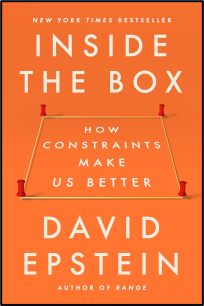
David Epstein is an American science journalist and author with master’s degrees in environmental science and journalism. He has worked as a senior writer for Sports Illustrated and as an investigative reporter for ProPublica. Inside the Box (May 2026) is his third book.
The book makes the counterintuitive case that all of us, individually or corporately, benefit from narrowing our options, and that constraints, rather than unlimited freedom, are what produce creativity, focus, and satisfaction. Whether the limits are external (scarce resources or hard deadlines) or self-imposed, the argument is that boundaries orient us more than bind us.
I find this confirmed in my own practice. My Substack publication schedule functions precisely as Epstein describes: a self-imposed constraint that forces me to focus, to maintain order, and paradoxically to encourage rather than suppress creative energy.
Although Epstein does not consider the spiritual dimension, his thesis also opens onto something deeper related to the teachings of Jesus operating as a kind of moral constraint toward forgiveness and a life shaped by love. Yet within those bounds, the tradition has always understood freedom to be clarified, not diminished. The Christian life is not restriction simply pretending to be free, but, as Epstein’s argument suggests, the condition under which genuine freedom becomes possible.]
Curated Quotes:
🔹 “Danish philosopher Søren Kierkegaard wrote about what he called the “dizziness of freedom.” He saw that the sheer weight of exploding choice—in matters of love, career, and faith—often led to dread and despair, as every decision carried the burden of infinite possibilities and the anxiety of taking the wrong path. In the twentieth century, German-born social psychologist Erich Fromm built on Kierkegaard’s ideas and wrote about the human reflex to “escape from freedom,” sometimes in productive ways, by throwing oneself into meaningful activities, or—as he saw around him—by submitting to authoritarianism.” [AB: As Epstein also writes about the result of excess freedom and choices, “A 2023 report from the Harvard Graduate School of Education that examined the extraordinary rates of anxiety and depression among young adults found them struggling with just the challenges Kierkegaard and Fromm highlighted; about three in five said they lack “meaning or purpose,” while half didn’t know what to do with their lives.”]
🔸 “We often overvalue limitless freedom and choice.” [AB: The book by Paul Kingsnorth, Against the Machine, makes a similar argument in support of limits.
There is a phenomenon called FOMO (“the fear of missing out”) that expresses our anxiety when faced with an overabundance of choices. The mere suspicion that something better might be out there can spoil the experience of the present moment. The phone held up to capture a video subtracts from our fully experiencing the moment.]
🔹 “In the 1960s, computer scientist Fred Brooks led the development of the IBM computers that NASA used to send humans to the Moon. He later founded the computer science department at the University of North Carolina. But he is most widely remembered for his popular writing on design and project management, including what became known as Brooks’s Law, the idea that adding people to a software project that is already late will make it even more late.” [AB: Fred Brooks was a legendary figure in my early computer science education.]
🔸 “The cognitive scientist Daniel Willingham has written: “Contrary to popular belief, the brain is not designed for thinking. It’s designed to save you from having to think.” Because the brain is naturally inclined to avoid effortful thinking and to rely instead on familiar patterns, complete freedom tends to lead to unoriginal ideas, simply repeating what is known. Constraints push the brain beyond its default tendencies, forcing it to engage in deeper problem-solving. Total freedom, then, is the enemy of creativity, and constraint its companion.”
🔹 “When anything is possible, it becomes nearly impossible to do anything new. Complete freedom, paradoxically, leads to conformity.”
🔸 “Soccer research found that players (including pros) more actively explored new tactics when they were put on small fields and at a numerical disadvantage, like playing four on five, or even four on seven, because the path of least resistance was no longer viable.” [AB: The same rationale has been applied to hockey. Austin Matthews’ stick-handling ability in confined spaces has been attributed to playing on a half rink as a youngster in Arizona.]
🔹 “The advertising industry actually has an apt saying: “Give me the freedom of a tight brief.” [AB: I feel the same about Manmade underwear.]
🔸 “Some papers relied on highly novel combinations of knowledge: They primarily cited areas of research that rarely (or never) appeared together. Others cited only familiar combinations that recur constantly. But the “hit” papers, those that went on to be used by a huge number of other scientists, struck a balance. Papers that were grounded in conventional knowledge combinations, but featured an injection of unusual combinations, were at least twice as likely as average papers to become scientific blockbusters.” [AB: Makes sense to build on an existing foundation.]
🔹 “In the late nineteenth and early twentieth century, Frederick Winslow Taylor, the “father of scientific management,” helped popularize the notion that individual differences should be ignored. As Taylor wrote: “In the past the man has been first; in the future the system must be first.” Taylor was focused on organizing factory labor and felt that efficient systems could overcome individual differences. [AB: Taylor was a typical representative of the age of quantity and algorithms, focused on the machine rather than the workers.]
🔸 “[Martin Luther King Jr.] once planned to use a jail stint to get some focused writing done, but—to his dismay—got released prematurely. It wasn’t until the following year, when he was put in a solitary cell, that he penned the famed Letter from Birmingham Jail, his seminal statement on nonviolent resistance. As King wrote in the letter: “What else can one do when he is alone in a narrow jail cell, other than write long letters, think long thoughts, and pray long prayers?”
🔹 “If the atomized normlessness of virtual life is harmful to development, what, in contrast, is helpful? According to the world’s longest in-depth study of health and happiness: chores.”
🔸 “One of the recommendations that has come out of that work is to give children chores from an early age. “It gives children a sense of community, so you are pitching into the family because your participation matters.” [AB: Provides children with a sense of responsibility, care about others, and ownership.]
🔹 “For adults, the overwhelming finding of the Harvard study is that strong social ties—to family, to friends, to community—are the best predictors of health, well-being, and longevity. The obvious commonality between the tips for kids and adults is that they involve obligation to something other than oneself. Obligations necessarily mitigate the “extreme personal freedom” that Haidt equated with anomie [a condition of social disorder and restlessness] and counteract life in an algorithmically tailored and hyper-individualized virtual world for one.”
🔸 “I had read plenty of psychology about the importance of having a coherent life story, a narrative that helps give a sense of who we are and how we fit. Over the course of a few years, I had pulled up many of my previous identity anchors. I had changed the place I lived, the work I did, and gone on my own as a professional.” [AB: Paul Kingsnorth, in Against the Machine, agrees. He identifies these anchors that root us as the ‘Four Ps’: Past, People, Place, and Prayer.]
🔹 “Wolf argues that meaning arises when “subjective attraction” meets “objective attractiveness.” That is: when we are drawn to do something that is both personally fulfilling and has clear worth from an outside perspective. One might feel a passionate pull toward music, or caregiving, or tech building, or scientific inquiry.”
🔸 “There is a common feature of all games, he said. It is a way of being, an attitude; the “lusory attitude,” he called it—the willing acceptance of constraints.”
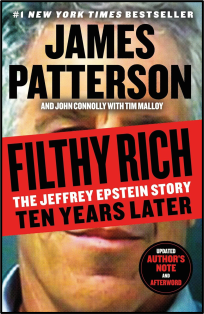
Filthy Rich: A Powerful Billionaire, the Sex Scandal that Undid Him, and All the Justice that Money Can Buy: The Shocking True Story of Jeffrey Epstein
James Patterson is one of the most commercially successful and prolific writers in publishing history. Filthy Rich marks a departure from his usual thriller fiction into true crime, co-authored with journalists John Connolly and Tim Malloy, who did much of the investigative groundwork: sourcing original police interviews, court transcripts, and details of the criminal proceedings against Epstein.
Much of the book reads like a transcript of those interviews and proceedings, and at times resembles a hastily assembled document. Some of its content is morally repulsive in its depiction of how Epstein preyed on underage girls. A more appropriate title might have been simply Filthy rather than Filthy Rich.
That the book is now ten years old only underscores how poorly justice has served the countless women and girls abused not only by Epstein but by everyone within his network. The last word on this Epstein episode has not yet been written.]
Curated Quotes:
🔹 “The thing about Epstein was that you never could figure him out. One minute he was charming. The most charming man you’d ever meet. The next he was snarl, threat, and bluster. Something didn’t add up. So you’d run the numbers: this many parties, that many women. Even with the connection to Victoria’s Secret, the women didn’t add up, either.
Throw in the modeling agency, it makes more sense. Then you plug in the parties. The scene brings Eyes Wide Shut to mind. But the thing is, Eyes Wide Shut only works in the shadows. For Epstein, getting on that plane with Clinton was more like a moment in Caddyshack—the one in which the groundhog peeks out from his hole in the golf course. From there on in, Jeffrey Epstein was like the mole in a game of whack-a-mole. It was only a matter of time before he’d be caught. But the question you had to ask yourself was, are people like Epstein born without morals? Or are their morals like snakeskin—just something they shed (along with all the other basic, day-to-day concerns that everyday working people have) as they make their way into that Eyes Wide Shut world?”
🔸 “Remarkably, despite assurances they’d received from the feds, none of the victims was consulted prior to the drafting of this NPA [non-prosecution agreement - it assured Epstein that he would not be prosecuted in the Southern District of Florida for felony offenses involving the sexual abuse of underage girls].
If Epstein did not sign the agreement, he faced a fifty-seven-count indictment and a decade or more in prison. But Epstein’s team of lawyers had gotten him a deal so sweet it could have rotted all the teeth in South Florida. For all his protestations of innocence, there was every reason in the world to agree to an NPA. On September 24, 2007, Epstein did sign it. Once again, none of the victims had been consulted or notified.”
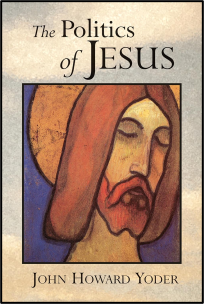
John Howard Yoder (1927–1997) was an American Mennonite theologian and ethicist, best known for his defense of Christian pacifism, who spent the latter part of his career teaching at the University of Notre Dame. The Politics of Jesus (1972) argues against the dominant view that Jesus was essentially apolitical, contending instead that radical Christian pacifism is the most faithful posture for his disciples.
My reading of the book left me persuaded by much of what Yoder says about the ethics of Jesus, but unconvinced by his case for the politics of Jesus. And his decades-long history of sexual abuse against numerous women casts a shadow over everything he wrote about discipleship and Christian ethics. That said, Yoder’s influence endures, and is perhaps nowhere more visible than in the work of Stanley Hauerwas.]
Curated Quotes:
🔹 “This study makes that claim [that there is breaking into common awareness a dimension of biblical truth that we—precisely the reverent and relevant ethicists—have been hiding from ourselves]. It claims not only that Jesus is, according to the biblical witness, a model of radical political action, but that this issue is now generally visible throughout New Testament studies.”
🔸 “Jesus did not come to teach a way of life; most of his guidance is not original. His role is that of Savior, and for us to need a Savior presupposes that we do not live according to his stated ideals.”
🔹 “The cross is beginning to loom not as a ritually prescribed instrument of propitiation but as the political alternative to both insurrection and quietism.”
🔸 “It is a general rule of proper textual interpretation that a text should be read for what its author meant to say and what its first readers or hearers would have heard it say. Whether the taking of human life is morally permissible or forbidden under all circumstances was not a culturally conceivable question in the age of Abraham or that of Joshua. It is therefore illegitimate to read the story of the planned sacrifice of Isaac or of the Joshuanic wars as documents on the issue of the morality of killing. Although the narrative of the conquest of Canaan is full of bloodshed, what the pious reader will have been most struck by in later centuries was the general promise according to which, if Israel would believe and obey, the occupants of the land would be driven out little by little (Exod. 23:29-30) by “the angel” (23:23) or the “terror” (v. 27) or the “hornets” (v. 28) of God, or the most striking victories of Joshua over Jericho (Josh. 6), or Gideon’s defeat of the Midianites (Judg. 7) after most of the volunteers had been sent home and the remaining few armed with torches in order (7:2) not to let Israel think military strength or numbers had brought the victory: To “believe” meant, most specifically and concretely in the cultural context of Israel’s birth as a nation, to trust God for their survival as a people.”
🔹 “God is not said to create or institute or ordain the powers that be, but only to order them, to put them in order, sovereignly to tell them where they belong, what is their place. It is not as if there was a time when there was no government and then God made government through a new creative intervention; there has been hierarchy and authority and power since human society existed. Its exercise has involved domination, disrespect for human dignity, and real or potential violence ever since sin has existed. Nor is it that by ordering this realm God specifically, morally approves of what a government does. The sergeant does not produce the soldiers he drills; the librarian does not create nor approve of the book she or he catalogs and shelves. Likewise God does not take the responsibility for the existence of the rebellious “powers that be” or for their shape or identity; they already are. What the text says is that God orders them, brings them into line, providentially and permissively lines them up with divine purposes.”
🔸 “It is not by accident that the imperative of [Romans] 13:1 is not literally one of obedience. The Greek language has good words to denote obedience, in the sense of completely bending one’s will and one’s actions to the desires of another. What Paul calls for, however, is subordination. This verb is based upon the same root as the ordering of the powers of God. Subordination is significantly different from obedience. The conscientious objector who refuses to do what government demands, but still remains under the sovereignty of that government and accepts the penalties which it imposes, or the Christian who refuses to worship Caesar but still permits Caesar to put him or her to death, is being subordinate even though not obeying.”
🔹 “The relationship between the obedience of God’s people and the triumph of God’s cause is not a relationship of cause and effect but one of cross and resurrection.”
🔸 “There is a widespread recognition that Western society is moving toward the collapse of the mentality that has been identified with Christendom. Christians must recognize that they are not only a minority on the globe but also at home in the midst of the followers of non-Christian and post-Christian faiths. Perhaps this will prepare us to see how inappropriate and preposterous was the prevailing assumption, from the time of Constantine until yesterday, that the fundamental responsibility of the church for society is to manage it.”
Next week’s Notable Quote: We pull a quote from Inside the Box. David Epstein never mentions spiritual life, yet the principles he identifies apply just as well to a fulfilling one.
![[Notes] and "Quotes" by Arnie Berg](https://substackcdn.com/image/fetch/$s_!pJ9d!,w_120,h_120,c_fill,f_webp,q_auto:good,fl_progressive:steep/https%3A%2F%2Fsubstack-post-media.s3.amazonaws.com%2Fpublic%2Fimages%2Fbb88adc7-d439-40a5-9080-eeed420c842d_1280x1280.png)
![[Notes] and "Quotes" by Arnie Berg](https://substackcdn.com/image/fetch/$s_!4edT!,e_trim:10:white/e_trim:10:transparent/h_72,c_limit,f_auto,q_auto:good,fl_progressive:steep/https%3A%2F%2Fsubstack-post-media.s3.amazonaws.com%2Fpublic%2Fimages%2F3c6bff99-5c60-4ffb-b72f-0a45a0e12514_1100x220.png)
![[Notes] and "Quotes"'s avatar](https://substackcdn.com/image/fetch/$s_!lQGu!,w_108,h_108,c_fill,f_webp,q_auto:good,fl_progressive:steep/https%3A%2F%2Fsubstack-post-media.s3.amazonaws.com%2Fpublic%2Fimages%2F37660695-8e60-4950-ac5f-4ec4f45b0cf4_1793x1793.jpeg)