![[Notes] and "Quotes" by Arnie Berg](https://substackcdn.com/image/fetch/$s_!pJ9d!,w_120,h_120,c_fill,f_webp,q_auto:good,fl_progressive:steep/https%3A%2F%2Fsubstack-post-media.s3.amazonaws.com%2Fpublic%2Fimages%2Fbb88adc7-d439-40a5-9080-eeed420c842d_1280x1280.png)
![[Notes] and "Quotes" by Arnie Berg](https://substackcdn.com/image/fetch/$s_!4edT!,e_trim:10:white/e_trim:10:transparent/h_72,c_limit,f_auto,q_auto:good,fl_progressive:steep/https%3A%2F%2Fsubstack-post-media.s3.amazonaws.com%2Fpublic%2Fimages%2F3c6bff99-5c60-4ffb-b72f-0a45a0e12514_1100x220.png)
Illuminating Insight: Don't become the tool
The most obvious AI dangers aren't the ones that will change you. The quiet one is the silent killer.
![[Notes] and "Quotes"'s avatar](https://substackcdn.com/image/fetch/$s_!lQGu!,w_108,h_108,c_fill,f_webp,q_auto:good,fl_progressive:steep/https%3A%2F%2Fsubstack-post-media.s3.amazonaws.com%2Fpublic%2Fimages%2F37660695-8e60-4950-ac5f-4ec4f45b0cf4_1793x1793.jpeg)

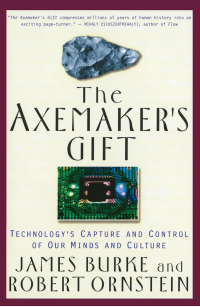
From last week’s Book Portrait The Axemaker’s Gift: Technology’s Capture and Control of Our Minds and Culture by James Burke and Robert Ornstein:
Don’t become the tool
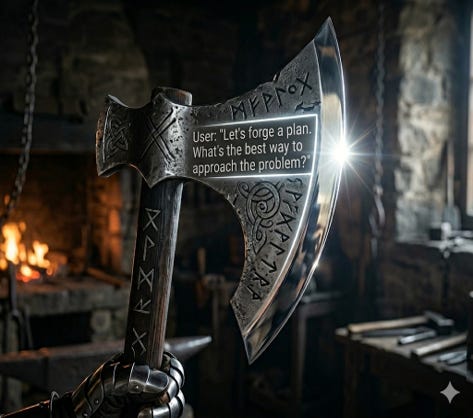
The axe cleared the forest. It also handed the few axe owners a power over everyone who needed the clearing done. Last week’s Book Portrait of The Axemaker’s Gift illustrated that while you gain the power that every tool gives you, it comes with the potential for abuse. It changes who you are, how you think.
The successful introduction of artificial intelligence in the form of Large Language Models like ChatGPT and Claude is no different in that sense, simply scaled up with great promise along with substantial risk.
What is the dangerous edge of AI that can harm a person, not to mention a society?
Two kinds of danger
There is one type of danger that is external and affects you whether you use AI or not, including:
Concentration of wealth and power
Mass surveillance, loss of privacy and security
Disinformation and deception
Job and career displacement
Data-center energy and water cost
You can see these coming, and they are serious issues and deserve thoughtful consideration. But that is not this article’s focus. A more personal danger that you may not see coming results from your own use of the tool. AI seems useful, powerful, convenient, fun even, but the danger can change you and your ability to think clearly.
The danger that changes you
You can hand off many tasks to AI, whether they are boring or challenging. But AI does not just get a free pass. While AI is happily doing those tasks, it is retraining the habits of our minds. A central concern of modernity has been that in addition to replacing human labour, mechanization reshapes human character.
“The more machines there are to replace men, the more men there will be in society who are nothing but machines.” – Louis de Bonald (early 1800s)
A study by Michael Gerlich of 666 people tied heavy AI use to weaker critical thinking, with “cognitive offloading” as the mechanism. We fail to thoroughly think through what we are expressing or trying to learn and end up de-skilling ourselves.
Cognitive offloading that says “Just give me the answer” is bypassing understanding. Cognitive offloading that says “Help me understand this better” offers a scaffold for deeper thinking. The real distinction between these two is that one substitutes for understanding and the other supports it.
Dr. Sam Illingworth reported on a study from Carnegie Mellon, Oxford, MIT and UCLA that examined the AI usage habits of 1,222 participants. The study found that only 27% of the participants used AI as scaffolding to gain understanding through hints and clarifications. AI itself does not make the work worse. It’s just that most participants “stop trying” and use AI to get copy-and-paste answers. The study puts it this way:
“When people prompted AI to solve tasks for them, they were less likely to persist with tasks compared to people who didn’t use AI or people who used AI to aid understanding.”
Nicholas Carr’s The Shallows: What the Internet Is Doing to Our Brains (2010) and Jonathan Haidt’s The Anxious Generation: How the Great Rewiring of Childhood Is Causing an Epidemic of Mental Illness (2024) are two books that warn about how the use of the internet, especially social media, is changing the mental habits of a whole generation in ways never experienced. AI use further amplifies the pressure on the shape of our mind.
As we constantly reach out to AI, Jim Stump from BioLogos says we become less human and take on AI’s form of intelligence, which he describes as “fast, frictionless, disembodied, optimized, and untroubled by love.” Ironically, as AI thinking is becoming more human, human thinking is becoming more like AI.
Beyond the strong possibility that AI makes us dull, lazy, anxious and unskilled, Ethan Mollick warns us that if we’re not careful, we’re handing judgment to something that does not always share our values and making poorer decisions in the process. In his book Co-Intelligence: Living and Working with AI, he states that “there is no particular reason that AI should share our view of ethics and morality.” Whether we like it or not, different AI models carry different ethical stances, based on by who aligned them and how well.
Pope Leo XIV’s encyclical Magnifica Humanitas (”Magnificent Humanity”) was published May 25, 2026, on safeguarding the human person in the age of AI.1 He reiterates the themes already stated and distinguishes between what AI imitates and what humans experience. He also pushes back against the idea that our limits are bugs to be fixed rather than features of creaturely existence.
The rapid improvement in AI capabilities makes it feel like AI is becoming too human. A greater worry is the concern that constant use of AI makes us less human. Pope Leo frames this difference with two Biblical images, the Tower of Babel and the rebuild of Jerusalem by Nehemiah.
Babel was technology built on human pride, uniformity and self-sufficiency, ending in confusion. The rebuild of Jerusalem’s walls was based on God-centered shared effort that ended in genuine community, where each family was given its own section of the wall. The choice stems from how we apply the technology available to us.
The conclusion returns to Christ as the measure of humanity:
“In the era of artificial intelligence, when human dignity is threatened by new forms of dehumanization, ours is the pressing duty to remain profoundly human. We must lovingly safeguard the grandeur of humanity bestowed upon us and revealed in its fullness in Christ, the splendor of which no machine can ever replace.”
In a recent Substack note, Leonard Sweet points out how vital that human part is because “ours is the only faith where God becomes a human being.” In contrast to the potential for AI to make us less human,
“Jesus came to show us how to be a Jesus human. Not an argument, brand, proposition, leader, or a side. A Jesus human.”
How to hold the axe
AI as a tool has a trailing edge that can cause us personal harm if we are not careful. What steps can you take to gain the benefit of AI and still not endanger yourself?
Mollick’s Co-Intelligence offers practical principles. Always consider how you might find AI useful, but be the human in the conversation and keep judgment for yourself. When you offload tasks like first drafts, hard reasoning and moral calls to AI, you have not come to a full understanding. Your moral and mental muscles begin to atrophy.
I must discipline myself to meet this standard. My writing on Substack is my own, but I appreciate what AI can do for me as a co-worker when it comes to giving me another perspective or challenging my assumptions. It’s the human part, my voice, that cannot be replaced.
AI is all too willing (and able) to offer me suggestions on how I might rethink certain assertions or restructure whole sections of a piece, then close with something like “Want me to mark these up inline on the draft, or take a pass at restructuring it for you?”, as it did in the writing of this article. It is a temptation I want to resist. The thinking and the writing need to stay authentically mine.
One line from Pope Leo XIV about the need to “disarm” AI caught my attention. In his understanding, disarming AI does not mean rejecting technology but preventing it from dominating humanity.
AI companies have likely not made ‘dominating humanity’ a high consideration in their quest for expanding the impact zone for AI. Until they do, be careful how you use it, so you don’t become the tool by letting AI become the master.
One final “prompt”
Much of how you approach AI is based on how you craft your prompts. Do you want to dump your thinking into AI and get a direct answer? That is fine when you prompt for a task that doesn’t require much thinking.
Next time you prompt ChatGPT or Claude, evaluate whether you are handing it a task or handing it your judgment. The first is a tool. The second is a master which demands part of your soul. Approach AI with the question: “What will make me wiser, more human?”
And finally, I am pleased to report that ZeroGPT.com rated this article on the first pass at 100% probability that it was written by a human!
Further Reading
1. ChatGPT Isn’t Just Changing How We Work. It’s Harming How We Think, Sheldon Fernandez, June 10, 2026
2. Co-Intelligence: Living and Working with AI, Ethan Mollick, 2025
3. Against the Machine: On the Unmaking of Humanity, Paul Kingsnorth, 2025
And yes, the weird rumor that the Pope used AI to write the encyclical has been flagged as unproven by Snopes.
[Notes] and “Quotes” at the end of this month will include the following books:
Stacey Abrams (2025, 432 pp.)
John Howard Yoder (1994, 271 pp.)
The Bible in Politics: How to Read the Bible Politically
Richard Baukham (2011, 192 pp.)
Feeling and Knowing: Making Minds Conscious
Antonio Damasio (2021, 256 pp.)
Co-Intelligence: Living and Working with AI
Ethan Mollick (2024, 256 pp.)
Against the Machine: On the Unmaking of Humanity
Paul Kingsnorth (2025, 368 pp.)
Inside the Box: How Constraints Make Us Better
David Epstein (2025, 304 pp.)
I appreciate your insights and cautions regarding AI. Personally I have found it, Claude, in particular, to be a powerful assistant when it comes to transcribing notes and writing some basic code. However, I have caught it cross-analyzing financial spreadsheets and confusing requests between tasks. So, after these experiences and absorbing your perspectives I am encouraged to beware of the axe! 🪓 Thanks for the incredible research and insights you share with us on a weekly basis! 👏