![[Notes] and "Quotes" by Arnie Berg](https://substackcdn.com/image/fetch/$s_!pJ9d!,w_120,h_120,c_fill,f_webp,q_auto:good,fl_progressive:steep/https%3A%2F%2Fsubstack-post-media.s3.amazonaws.com%2Fpublic%2Fimages%2Fbb88adc7-d439-40a5-9080-eeed420c842d_1280x1280.png)
![[Notes] and "Quotes" by Arnie Berg](https://substackcdn.com/image/fetch/$s_!4edT!,e_trim:10:white/e_trim:10:transparent/h_72,c_limit,f_auto,q_auto:good,fl_progressive:steep/https%3A%2F%2Fsubstack-post-media.s3.amazonaws.com%2Fpublic%2Fimages%2F3c6bff99-5c60-4ffb-b72f-0a45a0e12514_1100x220.png)
Illuminating Insight: Both Hands of the Kingdom
Waiting for a kingdom by working for it

From last week’s Book Portrait Kingdom Conspiracy: Returning to the Radical Mission of the Local Church by Scot McKnight
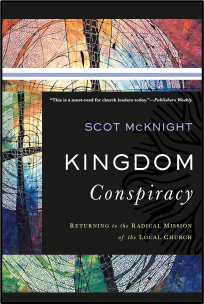

Practice for the day the King returns
Two thousand years ago Jesus told His followers He would come back. The Church has been waiting ever since. What happens in the waiting is McKnight’s subject in Kingdom Conspiracy.
His central claim is that the kingdom of God is the real kingdom. Jesus is the king. The Church is the people. The earth, eventually remade, is the land. And the kingdom of God has a way of life.
The kingdom is partly here already, in the Church. It will arrive in full when Jesus returns. Everything we do between now and then is practice for that day.
Last week’s Book Portrait explained McKnight’s two camps: The skinny jeans crowd equates kingdom work with doing justice: fight inequity and fix systems. The pleated pants crowd equates it with saving souls: get people to heaven.
McKnight argues that both camps have mistakenly redefined kingdom and removed it from the Church. People both inside and outside the kingdom of God can do good work. But good work is not kingdom work unless it rises out of the Church’s life.
This month’s Notable Quote showed how Jesus never separated the two. A woman caught in adultery: Let him who is without sin cast the first stone…Neither do I condemn you. A paralyzed man lowered through a roof: Your sins are forgiven. Get up, take your mat, walk.
Salvation is a state of being. Justice is a state of doing. McKnight argues both are worship. Both are how the Church practices the kingdom that is coming.
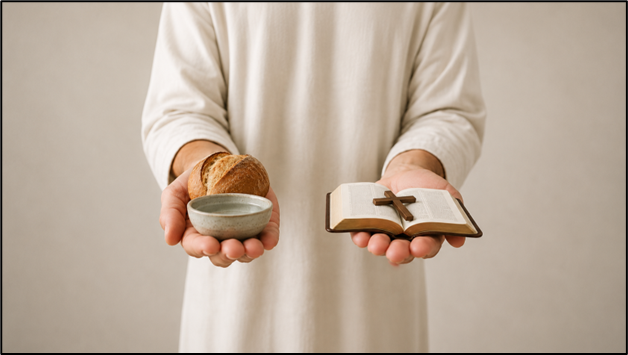
That is the both-handed life. One hand offers the news that Jesus is King. The other does the work of His kingdom. Drop either hand and you are doing something else.
So how does that play out during the week?
Both hands during the week
If you are married, you can read your spouse clearly, and vice versa. The same spouse who prays with you is the person who pouts and shouts in anger. In a good marriage, the kindness and love you show on every ordinary day is kingdom work.
Then kids, parents, siblings.
It is hard to pull the wool over the eyes of the family you live with and relate to on a regular basis. They have watched you long enough to know whether you are faithful in words and deeds.
Then friends.
You know your friends and their needs. Sometimes that means talking about Jesus and encouraging a more faithful spiritual journey. More often it means showing up when a parent dies, a marriage is falling apart, or a job opportunity is lost. One hand offers the hope of the King. The other brings a meal.
Then neighbors, bosses, coworkers, teachers, the broader public.
Politics happens here. In Resident Aliens (1989), Stanley Hauerwas makes the case that both the left and right wing of the Church have attempted to accomplish kingdom-work through politics. The conservative Church supports one party's platform, while the liberal Church supports the other. Each attempt to make the state carry out the Church's will. John Howard Yoder’s The Politics of Jesus echoes this sentiment. The Church has always been the politics of Jesus. What happens when you couple the Church with any earthly political power? The state loses its conscience, and the Church loses its integrity.
That cuts both ways. The Christian who confuses kingdom work with party victory has dropped the hand of salvation. The Christian who hides faith from public life has dropped the hand of blessing and justice.
Then the nation, and the world.
Most of us are not responsible for managing the emergency shelter or the soup kitchen. We may be tied down to a job and have only a few free hours on the weekend, but we can contribute what we have. There is Mission Thrift and The Mustard Seed and a hundred other faith-based outreaches. Every “cup of water” given through those groups was provided or paid for, partly, by someone who never met the recipient.
The “cup of water” counts even after passing through multiple hands. The donor cheque is kingdom work if it is given as part of the Church’s life under Christ. The same cheque given outside the scope of the Church is simply a civic favor with a charitable tax receipt.
Paul states the pattern in Ephesians 6. Slaves, obey your masters. Masters, treat your slaves the same way. He was writing to Roman people in what could be considered the service industry in the Roman economy. His instruction: do the work you do as worship. The work you do, well or badly, reflects which King you serve to anyone watching.
At the center of it all is the Church. A short Igniter Media video, In Here, Out There, makes the point. As the video states, the life we live out there has to start in here, in the gathered body. Without that core community, kingdom work becomes whatever cause we happen to care about, and we lose the use of one hand or the other.
Once again we hear the words of Amos warning the covenant community that their worship had become a lifeless ritual: Away with the noise of your songs. But let justice roll on like a river. The solution is to back up authentic worship with committed justice.
Recall my confession from the Book Portrait. I tend toward the skinny jeans error. Evangelism fades when I am focused on fixing systems. But I also cannot make peace with a faith that saves souls and lets the broken stay broken.
So we must reach out with both hands then. One offering the King. The other doing His work in every part of life, waiting for the day the King comes back and the practice becomes the performance.
A question for the week: If your spouse, your kids, and others you interact with all watched you for a month, would they see two hands of the same kingdom, or just one hand? If one hand, which one is more likely?
Further reading:
![[Notes] and "Quotes" for April 2026](https://substackcdn.com/image/fetch/$s_!IA_C!,w_140,h_140,c_fill,f_webp,q_auto:good,fl_progressive:steep,g_auto/https%3A%2F%2Fsubstack-post-media.s3.amazonaws.com%2Fpublic%2Fimages%2Fb826fbc4-360a-48a6-8d2c-b7d4075eb291_196x100.png)



[Notes] and “Quotes” at the end of this month will include the following books:
A World Appears: A Journey into Consciousness
Michael Pollan (2026, 320 pp.)
Joseph Selbie (2017, 208 pp.)
Spellbound: How Charisma Shaped American History from the Puritans to Donald Trump
Molly Worthen (2025, 464 pp.)
Warren Berger (2019, 288 pp.)
Resident Aliens: Life in the Christian Colony
Stanley Hauerwas (2014, 197 pp.)
The Hour of the Predator: Encounters with the Autocrats and Tech Billionaires Taking Over the World
Giuliano da Empoli (2025, 160 pp.)