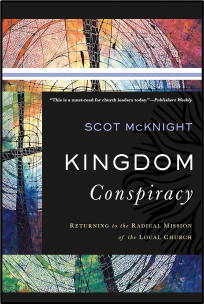
Kingdom Conspiracy: Returning to the Radical Mission of the Local Church - Scot
McKnight (2016, 300 pp.)
In last month’s Book of the Month,God’s Homecoming: A Study of God’s Dwelling, New Creation, and the Bible’s True Story, Tom Wright traced the Bible’s true story of God returning to dwell with his renewed creation, a homecoming that began in the incarnation, continues through the Spirit in the church, and will be complete when Christ returns to make all things new.
In this month’s Book of the Month, McKnight picks up exactly where Wright leaves off.
If Wright answers the question where is history going, McKnight asks the harder, more practical one: what are we supposed to be doing in the meantime? Specifically, what does it mean for the local church to do kingdom work, and how has “kingdom of God” been hijacked by everyone from social justice activists to culture warriors, leaving the church itself sidelined from its own mission?
His answer is both clarifying and unsettling. The kingdom of God, he argues, is not a set of good values to be applied in the public square for the common good, nor a spiritual atmosphere to be cultivated in the individual heart. It is a people, under a king, with a way of life. Which means kingdom mission is not something done alongside the church. Kingdom mission ischurch mission. The ordinary and often flawed local congregation is the primary place where God’s redemptive work in the world actually happens.
That claim has important consequences. It redirects the question of what we are here for, and with it every subsequent decision: how we set our priorities, spend our time and money, and show up for our family, friends, and neighbors.
A full Book Portrait on Kingdom Conspiracy is coming in May — the first time the Book Portrait and the Book of the Month have featured the same title.
“To acquire the habit of reading is to construct for yourself a refuge from almost all the miseries of life.”
— W. Somerset Maugham
A Publishing Note!!!
The next two months will bring shorter editions of Notes & Quotes than usual.
After 31 years in the same home, we are “packing and moving”, and learning how much one accumulates in three decades. We hope to be settled in our new address by mid-June. Let the chaos begin!
In the meantime, the reading continues, even if abbreviated. Thank you for your patience, and for staying with this little project.
List of book blurbs for April 2026
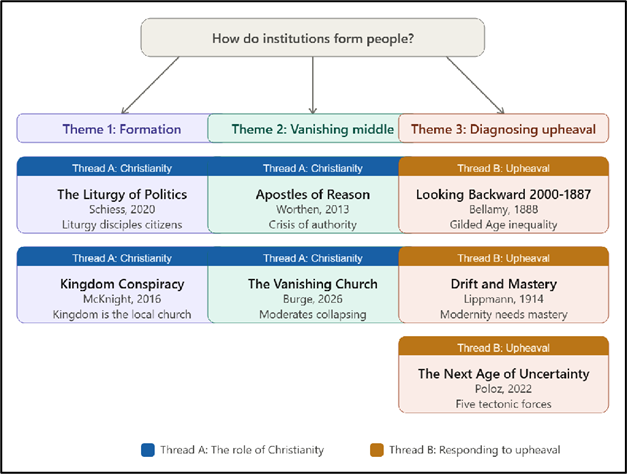
This month’s reading list weaves together two major threads of inquiry:
Therole of Christianity (particularly evangelicalism and moderate Protestantism) in public life
Four of the books (Schiess, Worthen, McKnight, Burge) examine how the church forms believers politically, navigates intellectual authority, defines its mission, and shapes democratic life.
Thediagnosis of social, economic, and political upheaval across different eras.
The other three (Bellamy, Lippmann, Poloz) are works of social and economic diagnosis spanning 134 years, each attempting to make sense of disruption: industrial capitalism’s discontents in the 1880s, Progressive-era anxieties in 1914, and post-pandemic uncertainty in the 2020s.
Read together, this month’s collection asks a unified question: how do churches, governments, and economies form people and respond to upheaval?
The religious books interrogate Christian formation and witness, while the diagnostic books interrogate the broader civic conditions in which that witness occurs. Bellamy and Lippmann in particular offer historical reference points for the kinds of social fragmentation that Burge and Schiess address in our own timeline.
Theme 1: Christian Political Formation and Public Witness
Schiess argues that everyone is being politically discipled by something, and the church’s liturgies must consciously form Christians for faithful public engagement rather than ceding that formation to partisan media and ideologies.
McKnight contends that “kingdom” in the New Testament is inseparable from the local church, pushing back on both activist “kingdom-as-social-justice” and individualist “kingdom-as-personal-salvation” readings.
How they connect: Both books wrestle with where the church’s mission happens. Schiess focuses on formation within the gathered body for the sake of public life; McKnight focuses on locating kingdom work as the gathered body. They are complementary correctives to a Christianity that outsources its identity to politics.
Worthen traces postwar American evangelicalism as a movement fractured by an unresolved crisis over the sources of authority (Scripture, reason, tradition, and experience) and the inability to settle who gets to decide.
Burge uses survey data to show that mainline and theologically moderate congregations are collapsing and argues this disappearance harms civic life because moderates were the connective tissue between faith communities and democratic pluralism.
How they connect: Worthen explains the intellectualfragility of American Protestantism’s center; Burge documents the demographic collapse of that center decades later. Together they form a before-and-after: Worthen shows why the institutional cohesion couldn’t hold, and Burge measures what was lost.
Both also pair productively with Schiess and McKnight, since the absence of theologically grounded, civically engaged moderate churches is the gap those authors are trying to fill.
A Bostonian citizen falls asleep in 1887 and wakes in the year 2000 to find that industrial capitalism has been peacefully replaced by a cooperative nationalist economy. The story suggests that late 19th-century inequality could be a solvable problem rather than a permanent condition.
Lippmann argues that the modern age requires Americans to abandon nostalgic “drift” with the past and embrace conscious, scientific “mastery” of social and economic life through deliberate institutional design.
A former Bank of Canada governor identifies five global tectonic forces that will make the coming decades structurally riskier and require new policy frameworks.
How they connect: These three books are diagnostic studies separated by a century and a half but sharing the same approach: identifying systemic forces and proposing institutional responses. Bellamy responds to Gilded Age inequality with imagined transformation; Lippmann responds to industrial modernity by calling for rational governance; Poloz responds to 21st-century volatility by calling for adaptive risk management.
The diagnostic books (Theme 3) and the church books (Themes 1 and 2) speak to each other more than they might first appear to. Bellamy and Lippmann were writing in eras when Western Protestantism was a dominant civic force. The Social Gospel was Bellamy’s near-contemporary, and Lippmann’s call for “mastery” arrived alongside mainline Protestantism’s peak influence. Burge’s argument about vanishing moderate congregations is a sociological reflection of the civic question Lippmann raised: what institutions form citizens capable of navigating complexity?
Schiess’s worry about formation, Worthen’s about authority, and McKnight’s about mission all become more urgent against the backdrop Poloz describes—a riskier, more disorienting future in which the institutions that once shaped public life are themselves under strain.
Now, back to reading!
We hope you find something of interest in this month's selections and look forward to your feedback! My goal is simply to share a bit of my reading experience in hopes of sparking interest and awareness among readers. My hope is that as you read through the Notes and Quotes, you won’t just superficially skim the surface of the book, but that you’ll really get a feel for the heart and soul of the book and connect with the author’s deeper message.
My intent is to provide:
Notes on each book I’ve read this month (bracketed by ‘[AB: …]’).
Standout quotes from the book (bracketed in quotes).
No formal ratings or recommendations—just highlights that give a flavor of the book.
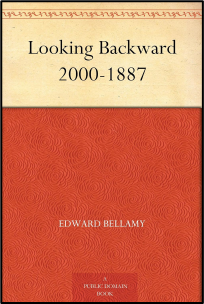
Edward Bellamy (1850–1898) was an American novelist, journalist, and political reformer best known for his utopian novel Looking Backward, 2000–1887, one of the most influential books of the late 19th century. The novel imagines an American society in the year 2000 transformed into a cooperative, centrally planned, egalitarian utopia, an appealing vision in a Gilded Age marked by inequality, labor unrest, and rapid industrialization. In some respects, Bellamy’s work shares the same intent as George Orwell’s 1984: both attempt to project the future to critique the present, though Bellamy offers a hopeful future while Orwell presents a dystopian one.
Bellamy frames his story around a man who falls into a trance‑like sleep and awakens 113 years later in the year 2000, Rip‑van‑Winkle style. This device allows the author to contrast the brutal realities of his own era with an imagined future shaped by rational planning and social harmony. A romantic subplot and a final twist give the narrative additional substance and intrigue.
His technological predictions reveal both insight and limitation. Bellamy extrapolates from the telephone to imagine large, centralized communication systems, but he could not foresee wireless technology, portable devices, or anything resembling the iPod or Spotify, technologies that actually defined the years following 2000. His vision expands the scale of existing tools rather than anticipating their transformation.
Where Bellamy under‑reaches technologically, he over‑reaches morally. His future society is free of vice, conflict, and self‑interest, reflecting an optimism that reads more like wish-fulfillment than prediction. The book also reflects the gender assumptions of its time: the perspective is overwhelmingly male, with women appearing mostly in supportive or decorative roles rather than as full participants in the utopian order.
The book lays out a detailed blueprint for an economic and political utopia grounded in progressive and socialist ideals. It assumes the basic goodness and perfectibility of humanity, shaped primarily through state education. Statements such as “The only coin current we have is the image of God, and that is good for all we have” reflect the high confidence of late‑19th‑century liberal Christianity in moral uplift and human progress.
🔹 “A system of direct distribution from the national storehouses took the place of trade, and for this money was unnecessary.”
“How is this distribution managed?” I asked.
“On the simplest possible plan,” replied Dr. Leete. “A credit corresponding to his share of the annual product of the nation is given to every citizen on the public books at the beginning of each year, and a credit card issued him with which he procures at the public storehouses, found in every community, whatever he desires whenever he desires it. This arrangement, you will see, totally obviates the necessity for business transactions of any sort between individuals and consumers. Perhaps you would like to see what our credit-cards are like.
“You observe,” he pursued as I was curiously examining the piece of pasteboard he gave me, “that this card is issued for a certain number of dollars. We have kept the old word, but not the substance. The term, as we use it, answers to no real thing, but merely serves as an algebraical symbol for comparing the values of products with one another. For this purpose they are all priced in dollars and cents, just as in your day. The value of what I procure on this card is checked off by the clerk, who pricks out of these tiers of squares the price of what I order.”
🔸 “From among the former heads of departments who may be eligible at the time, the President is elected by vote of all the men of the nation who are not connected with the industrial army.” [AB: In 1887, obviously women did not vote.]
🔹 “As for the comparatively small class of violent crimes against persons, unconnected with any idea of gain, they were almost wholly confined, even in your day, to the ignorant and bestial; and in these days, when education and good manners are not the monopoly of a few, but universal, such atrocities are scarcely ever heard of. You now see why the word “atavism” is used for crime. It is because nearly all forms of crime known to you are motiveless now, and when they appear can only be explained as the outcropping of ancestral traits. You used to call persons who stole, evidently without any rational motive, kleptomaniacs, and when the case was clear deemed it absurd to punish them as thieves. Your attitude toward the genuine kleptomaniac is precisely ours toward the victim of atavism, an attitude of compassion and firm but gentle restraint.” [AB: His comments about the transformative power of universal education and the heightened morality he expected by the year 2000 convey a striking confidence in humanity’s capacity for self‑improvement.]
🔸 ““You don’t mean that the man who pleads not guilty is thereupon discharged?”
“No, I do not mean that. He is not accused on light grounds, and if he denies his guilt, must still be tried. But trials are few, for in most cases the guilty man pleads guilty. When he makes a false plea and is clearly proved guilty, his penalty is doubled. Falsehood is, however, so despised among us that few offenders would lie to save themselves.”
“That is the most astounding thing you have yet told me,” I exclaimed. “If lying has gone out of fashion, this is indeed the ‘new heavens and the new earth wherein dwelleth righteousness,’ which the prophet foretold.” [AB: A striking example of Bellamy’s belief that modern humanity could achieve moral righteousness apart from divine grace.]
🔹 “Already accustomed to accept money for commodities, the people next accepted promises for money, and ceased to look at all behind the representative for the thing represented. Money was a sign of real commodities, but credit was but the sign of a sign.”
🔸 “Our women, as well as our men, are members of the industrial army, and leave it only when maternal duties claim them. The result is that most women, at one time or another of their lives, serve industrially some five or ten or fifteen years, while those who have no children fill out the full term.” [AB: Bellamy envisions women participating in the workforce, but only to a limited extent compared with men, reflecting the gender assumptions of his era.]
🔹 “In your day there was no career for women except in an unnatural rivalry with men. We have given them a world of their own, with its emulations, ambitions, and careers, and I assure you they are very happy in it. It seems to us that women were more than any other class the victims of your civilization. There is something which, even at this distance of time, penetrates one with pathos in the spectacle of their ennuied, undeveloped lives, stunted at marriage, their narrow horizon, bounded so often, physically, by the four walls of home, and morally by a petty circle of personal interests.” [AB: It’s hard not to wonder whether this is the kind of “liberation” feminism would recognize.]
🔸 “It was the sincere belief of even the best of men at that epoch [around 1887] that the only stable elements in human nature, on which a social system could be safely founded, were its worst propensities. They had been taught and believed that greed and self-seeking were all that held mankind together, and that all human associations would fall to pieces if anything were done to blunt the edge of these motives or curb their operation. In a word, they believed––even those who longed to believe otherwise––the exact reverse of what seems to us self-evident; they believed, that is, that the anti-social qualities of men, and not their social qualities, were what furnished the cohesive force of society. It seemed reasonable to them that men lived together solely for the purpose of overreaching and oppressing one another, and of being overreached and oppressed, and that while a society that gave full scope to these propensities could stand, there would be little chance for one based on the idea of cooperation for the benefit of all. It seems absurd to expect any one to believe that convictions like these were ever seriously entertained by men; but that they were not only entertained by our great-grandfathers, but were responsible for the long delay in doing away with the ancient order, after a conviction of its intolerable abuses had become general, is as well established as any fact in history can be.”
🔹 “No sooner had the nation become the sole capitalist and employer than not alone did plenty replace poverty, but the last vestige of the serfdom of man to man disappeared from earth. Human slavery, so often vainly scotched, at last was killed. The means of subsistence no longer doled out by men to women, by employer to employed, by rich to poor, was distributed from a common stock as among children at the father’s table. It was impossible for a man any longer to use his fellow-men as tools for his own profit. His esteem was the only sort of gain he could thenceforth make out of him. There was no more either arrogance or servility in the relations of human beings to one another. For the first time since the creation every man stood up straight before God. The fear of want and the lust of gain became extinct motives when abundance was assured to all and immoderate possessions made impossible of attainment. There were no more beggars nor almoners. Equity left charity without an occupation. The ten commandments became well-nigh obsolete in a world where there was no temptation to theft, no occasion to lie either for fear or favor, no room for envy where all were equal, and little provocation to violence where men were disarmed of power to injure one another. Humanity’s ancient dream of liberty, equality, fraternity, mocked by so many ages, at last was realized.” [AB: We are, quite obviously, still waiting to see this vision of moral and social perfection materialize.]
🔸 “Now that the conditions of life for the first time ceased to operate as a forcing process to develop the brutal qualities of human nature, and the premium which had heretofore encouraged selfishness was not only removed, but placed upon unselfishness, it was for the first time possible to see what unperverted human nature really was like. The depraved tendencies, which had previously overgrown and obscured the better to so large an extent, now withered like cellar fungi in the open air, and the nobler qualities showed a sudden luxuriance which turned cynics into panegyrists and for the first time in human history tempted mankind to fall in love with itself. Soon was fully revealed, what the divines and philosophers of the old world never would have believed, that human nature in its essential qualities is good, not bad, that men by their natural intention and structure are generous, not selfish, pitiful, not cruel, sympathetic, not arrogant, godlike in aspirations, instinct with divinest impulses of tenderness and self-sacrifice, images of God indeed, not the travesties upon Him they had seemed.”
🔹 “In place of the dreary hopelessness of the nineteenth century, its profound pessimism
as to the future of humanity, the animating idea of the present age is an enthusiastic conception of the opportunities of our earthly existence, and the unbounded possibilities of human nature. The betterment of mankind from generation to generation, physically, mentally, morally, is recognized as the one great object supremely worthy of effort and of sacrifice. We believe the race for the first time to have entered on the realization of God’s ideal of it, and each generation must now be a step upward.” [AB: Where Bellamy locates humanity’s “salvation” in “the unbounded possibilities of human nature”, the Gospel offers a very different foundation. As 1 Peter 1:18–25 reminds us, redemption does not arise from human progress or moral uplift but from the sacrifice of Christ, a hope grounded not in human perfectibility but in God’s enduring word:
“For you know that it was not with perishable things such as silver or gold that you were redeemed from the empty way of life handed down to you from your ancestors, but with the precious blood of Christ… For,‘All people are like grass,and all their glory is like the flowers of the field;the grass withers and the flowers fall,but the word of the Lord endures forever.”]
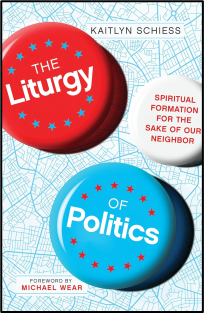
Kaitlyn Schiess is an American theologian and author whose work explores the intersection of Christian spiritual formation and political life. She is currently a doctoral student in theology and ethics at Duke Divinity School, following earlier studies in systematic theology at Dallas Theological Seminary.
Schiess has become widely recognized for helping Christians think more historically and faithfully about how Scripture shapes public engagement. Her most recent book, The Ballot and the Bible (2023), impressed me enough to lead me back to her earlier work, The Liturgy of Politics (2020), which argues that political engagement is formed through spiritual habits, communal practices, and the “liturgies” of everyday life.
I especially appreciate Schiess’s insistence that our spiritual formation and liturgies must be shaped by the perspective of the book of Revelation, and that this eschatological vision calls us to work faithfully for the Kingdom of God in the present.]
Curated Quotes:
🔹 “If a growing number of Christians decided their faith had implications for their politics, would that not change our politics? Could we not see our politics pulled toward a greater appreciation for human dignity? For justice? For humility? This is spiritual formation for the sake of our neighbors. For too long, we have only asked what politicians must do in order to meet our needs. Now, we must seek to become the kind of people our politics, and our neighbors, need.” [AB:From the introduction by Michael Wear.]
🔸 “A variety of explanations exists for this surge in conservative activism among church leaders and lay Christians, but the predominant explanation goes like this: evangelicals were happily apolitical until Roe v. Wade, when, motivated by theological opposition to abortion, they entered into the political world, eventually adding other cultural issues to their platform. Yet historian Randall Balmer calls this the “abortion myth.” In reality, the 1974 Internal Revenue Service decision to revoke the tax-exempt status of Bob Jones University, due to their ban on interracial dating, was the primary catalyst. Many private all-white schools or universities (often Christian) that were formed in response to the Brown v. Board of Education decision to desegregate public schools were similarly stripped of their tax-exempt status. [AB:Although the challenge to the tax‑exempt status of Christian schools served as the initial catalyst for the political mobilization of the 1980s, abortion and other cultural issues soon emerged as the unifying rallying points for a much broader constituency.]
🔹 “Younger Christians have never tasted the kind of cultural power that previous generations watched deteriorate. The “culture war” approach is unappealing to a generation thoroughly accustomed to a world that labels their religious beliefs “irrelevant” or “backward.” Instead, many are looking for political engagement that wrestles with the difficulty of applying theological convictions to public life and an approach to culture that does more than condemn.”
🔸 “Our idols of power, privilege, and wealth will ask us to gain power we can’t get without taking it from other people, privilege we can’t gain without exploiting other people, and wealth we can’t gain without stealing it from others. Our political participation is at unique risk of idolization precisely because it is so tangled up with these idols.”
🔹 “If we avoided everything that has formative power in our lives, we wouldn’t do anything. Our educational institutions are formative spaces, our workplaces are formative spaces, our places of entertainment and commerce are formative spaces. This is the tension that we live in as we make our way in a world that God created good and sin has corrupted: humans were made to creatively and authoritatively work and play on this earth, and yet our work and play is never without the effects of sin. Our response to these liturgies should not be avoidance or total rejection but careful engagement and productive criticism.”
🔸 “For those of us experiencing or healing from trauma, walking through suffering, or repenting from destructive sin in our lives, sustained attention to the inner spiritual life is necessary. But as pastor and seminary professor Barry Jones puts it, “When these emphases are elevated to the place of prominence that they sometimes receive, the result can be a truncated vision of Christian spirituality, one that is more concerned with getting us out of the world and the world out of us rather than leading us into the world for the sake of the world.”
🔹 “In one way or another, almost any political or moral issue is about the honor and protection of human beings. In reality, every piece of legislation is trying to legislate morality. Every policy issue is based on moral principles and has moral implications. Figuring out how to apply the scriptural principle that God holds all nations and people accountable for the protection and honor of human life in political discussions today is tricky, but it must be attempted.”
🔸 “The gospel comes with an ethical imperative to love our neighbor, and Scripture is clear that loving our neighbor means opposing social and political barriers to their flourishing.”
🔹 “In their fantastic work on church ministry and culture, Resident Aliens: Life in the Christian Colony, Stanley Hauerwas and William Willimon argue that both fundamentalists (the “conservatives”) and proponents of the historical-critical method (the “liberals”) have the same problem with the Bible: they “assume that it is possible to understand the biblical text without training, without moral formation, without the confession and forgiveness that come about within the church.”
🔸 “What we fail to recognize is that our churches are often the result of fragmentation, not at all the solution to it. We can’t pat ourselves on the back for maintaining a unified church if all we’re looking at are the people who show up on a Sunday morning. We need to ask who is absent, not necessarily by literal barrier but by social and economic divisions we have failed to properly dismantle in our own community. If our churches are not truly welcoming places for the poor and marginalized, we might not even notice those people being absent. That’s not unity—that’s discrimination.”
🔹 “Political scientist Ronald Beiner argues that modernity has required that religious convictions be adapted in one of two ways: civil religion or liberalism. Either the church is empowered for the sake of creating national citizens or it is relegated to the realm of private belief and experience.
Evangelicals may oscillate between these two options. On one hand, the Religious Right is evidence of the creation of a civil religion that marries limited government and social conservatism with loosely religious convictions. On the other hand, the church is depoliticized: our faith is relegated to the private sphere, and our political convictions are free to be pragmatic and morally relative. Without Scripture exerting moral authority over the church, it becomes a voluntary association united by right thinking, faith becomes a private commitment, and public morality becomes flexible. When our faith merely informs our political practices and moral habits, we are using it as one source among many, taking its truths and translating them through layers of other sources of moral knowledge.”
🔸 “White American Christians in particular would benefit from a reminder that we are not the main characters in Scripture. In fact, we are greatly removed—culturally, historically, and geographically—from the Scripture that is supposed to structure our lives.”
🔹 “Noll argues that the “persistent problem of Protestant biblicism” creates an inability to recognize or address cultural influences on our interpretation—both the ways that these influences will predispose us to certain conclusions and how these circumstances may require different application in different cultures or time periods. This is usually combined with hermeneutical naivete—our persistent claim that the Bible has a plain meaning universally accessible to everyone in all cultures and from all backgrounds. Instead of recognizing our own biases, the need for thorough study and learning from others, and our displacement from the histories and cultures of Scripture, we insist that we can just read the words and have sufficient understanding. Reading Scripture with the recognition of our own biases, humble engagement with the global and historic church, and special attention to marginalized voices will transform us and our churches.”
🔸 “The church and state are limited in their authority, but that doesn’t mean that either are politically or spiritually neutral. The state doesn’t have jurisdiction over worship and theological convictions, but its actions are theologically significant; likewise, the church doesn’t have jurisdiction over legislative matters, its actions are politically significant.”
🔹 “We can understand the relationship between church and state authorities as a difference in time: one is fading away while the other bears witness to a coming reality. This temporal government is not replaced by an apolitical reality but by a truer political reality, one in which humans exercise their creative capacities in total freedom and righteousness, unconstrained by our own sin and by the powers and principalities operating in a fallen world.”
🔸 “We are a people with a commission to seek the flourishing of creation. If the church is an “eschatological embassy”—an outpost of another kingdom living in occupied territory—then its work in the world must begin with the training of its people.”
🔹 “The fact that the constituting practices of the church are firmly rooted in physical realities has great political import. Spiritual practices rooted in physical habits remind us of our identification with the material suffering of the world. “What more than the human body and its needs makes us present in the world?” Virtual or internet church may be a beautiful use of technology for disabled or marginalized people, an opportunity for long-distance connection to a home church, or reaching those who would otherwise never darken the door of a church. But the loss of physical presence is a cost so high that it should be nothing but occasional when necessary.”
🔸 “The most politically significant aspect of our faith is the reality that it is birthed and nurtured in an alternate political community that serves another king and awaits another kingdom. Jesus wasn’t making converts—individuals who would pledge their individual support of him as a religious leader—but citizens of a new kingdom.”
🔹 “If “we are what we eat” applies to the songs we sing, we have an overly individualistic diet. Many of the songs sung in evangelical churches focus on individual salvation rather than cosmic redemption. We conceive of the power of Christ’s redemptive work on the cross in largely individual terms, which leaves us with largely individual concepts with which to think about our lives and work in the world. If the only real problem is the hearts of fallen people, we will rightfully evangelize and disciple people but neglect to address the systemic forces that keep them in poverty or oppression.”
🔸 “Through activism we confront toxicity in our world; through contemplation we confront it in ourselves.” [AB: Epigraph by Phileena Heuertz from chapter 8: Bent on the Coming Kingdom of God.]
🔹 “We’re distinguishing the disciplines because they are in a sense individually practiced, not because the things we do corporately are for the sake of the church and the things we do individually are for our own sake. Spiritual disciplines are practices for a community to reform its way of life together, to individually practice the story that we tell corporately, to put in place habits and postures that make every area of our lives look more like the shape of the kingdom of God we proclaim together in worship.”
🔸 “If we’re going to pray for God to protect and provide for the foreigner, the widow, and the vulnerable, we should also be willing to be the answer to our own prayers.”
🔹 “The Lord’s Prayer is immediately and undeniably communal, for “Even to pray this prayer in private is to pray a corporate prayer, for we do not address God as ‘my Father,’ but ‘our Father.’ We do not pray for ‘my daily bread,’ but ‘our daily bread.’” We are not alone in our relationship with God, giving voice to private desires that do not affect others; we are communing with the God who makes us into his people, the God who hears the prayers of all of us together—including those in the family of believers who look, speak, and act differently than us. We do not approach God with merely individual concerns and praises, but with the heart and voice of a community.”
🔸 “The Lord’s Prayer is also a political manifesto: your kingdom come, your will be done, on earth as it is in heaven (Matthew 6:10). We declare in every prayer that we are seeking, supporting, and desiring another kingdom and asking the king to bring it to fruition.”
🔹 “Just as we are powerless to save ourselves, we are powerless to produce spiritual growth in our own lives and the life of our community. C. S. Lewis said that when we practice “religious duties” we are “like people digging channels in a waterless land, in order that when at last the water comes, it may find them ready.” Practicing the spiritual disciplines prepares us for the work of the Holy Spirit. It’s a little like learning a foreign language by living in another country—we place ourselves in the best possible place to learn, open ourselves up to learning the language through the help of others, and trust that our immersion will produce the knowledge in us.”
🔸 “Political work can be right and good without being successful or permanent, so Christians are freed from attachment to any particular political structure and flexible enough to remain faithful in whatever context or circumstances they find themselves.”
🔹 “In the face of apocalyptic fear-mongering or grandiose assertions about the overriding importance of lesser-of-two-evils choices, this refusal to give weighty significance to historical events provides a more faithful, consistent, and God-dependent way of engaging politically. Because Christians cannot judge the significance of political events within the historical arc, every critique is flexible and ad hoc. There are no eternal pronouncements against particular policies or systems unless based explicitly in Scripture, and there is freedom to work within a variety of structures and with people of various backgrounds and convictions.”
🔸 “We are so often constrained in our political thinking and decision making by forces that trick us into thinking that our options are severely limited and the consequences for working outside of them are great. We need our political imaginations enlarged to help us think outside of the constraints of pragmatism, our own historical moment, and the dominating stories of our earthly political communities.”
🔹 “If the church’s eschatology is a cryptic academic exercise, it won’t affect her daily life together and her work in her community. However, the orientation of all people, communities, and institutions is toward some end: we are living and working and creating toward a vision of where the world is headed. Dietrich Bonhoeffer said that the church “witnesses to the end of all things. It lives from the end, it thinks from the end, it acts from the end, it proclaims its message from the end.” The church, as a community of people who do not believe that reality is bound by what we see and hear around us, especially lives and proclaims its message from the position of the “end” we envision—but what end? What are the current consequences of an immaterial, disembodied, “floating in the clouds” vision of the end? And what are the current consequences of a material, redeemed vision of the end?”
🔸 “If the coming destruction of the earth is anything like the flood, the destruction will not be total: Noah and his family and the animals are all saved, and the actual earth is still intact when the waters subside. The flood was a cleansing much like the “fire” that will “lay bare” the earth to God’s judgment.” [AB: 2 Peter 3:10 The implication is that the earth is not destroyed in God’s final judgment but preserved to be redeemed.]
🔹 “We are not biding our time on earth, waiting to be snatched away to an immaterial eternity. We are working on earth with the knowledge that every true work of human flourishing, done in the name of Jesus and by the power of the Holy Spirit, is a preview of the day that God’s good creation is redeemed. Our political commitments should be centered around the question of what kind of communities, families, institutions, and natural environment will exist in eternity, and how we can seek glimpses of them today. If our understanding of the end of the story is a world that will be destroyed so we can live immaterial lives in heaven, our political decisions have more to do with short-term stability for spiritual work. The vulnerable and marginalized are usually the greatest victims of our belief that the kingdom of God is an immaterial, disembodied reality, because we fail to prioritize the material conditions that affect them now.”
🔸 “Our understandings of Revelation must be informed by marginalized communities. A theology born out of resistance to political authorities from an oppressed position cannot result in private piety and political quietism unless it is read and practiced by the privileged. The most powerful readings of Revelation will always come from marginalized communities or those actively involved in opposition to unjust political systems.” [AB: As she states, “in some places and contexts today, the church still very much occupies this position, but this is not true for many American churches.”]
🔹 “James K. A. Smith says that Christian worship should give us a kind of inertia that is politically important, because we know that we are not sustained by political victory or social change but by the promises and faithfulness of God. “Lift up your hearts!” is a political admonition we hear every week. Worship like this is a prominent theme in Revelation, depicting worship as the source of our resistance to idolatry and foretaste of the worship of the whole creation. God’s kingdom has already come because there is a people who worship the rightful ruler.”
🔸 “The way Christians change the world in Revelation is by worshiping God and trusting in his power and bearing witness to the kingdom. It’s not by accumulating power at all costs or sacrificing convictions for the sake of particular hot-button issues, but it’s also not by retreating from public life and the pressures of oppressive human authority. Instead, the church performs ongoing apocalyptic work: revealing the temporality and fragility of seemingly all-powerful authorities by worshiping the truly omnipotent God. We live in the tension between the future and the present, witnessing to the coming age while retaining a prophetic presence in the present.”
Molly Worthen is a professor of history at the University of North Carolina at Chapel Hill and a freelance journalist. She earned both her BA and PhD from Yale University, specializing in American religious history, and writes regularly for major publications such as The New York Times. Recent reporting notes that Worthen, who grew up in a largely secular environment and long described herself as agnostic, converted to evangelical Christianity in 2022, influenced in part by pastors and scholars she encountered through her research.
Her book serves as a major study of the crisis of authority within American evangelicalism since 1945, tracing how competing sources of truth, leadership, and identity have shaped the movement’s development.]
Curated Quotes:
🔹 “There is no denying that the Bible has tremendous power among evangelicals, or that pastors, activists, and other leaders wield influence over their flocks. However, evangelicals are less like Jesus and more like Jacob. They constantly wrestle with the forces that rule them.”
🔸 “Three questions unite evangelicals: how to reconcile faith and reason; how to know Jesus; and how to act publicly on faith after the rupture of Christendom.”
🔹 “Inerrancy came to represent not only a set of beliefs about creation or the reality of Jesus’s miracles, but the pledge that human reason must always bow to the Bible. As fear of modernist theology and new science began to infect a wide range of Protestant churches, this new variety of fundamentalist deployed inerrancy as a simple shibboleth to separate the sheep from the goats. It was no longer a doctrine with historical roots or an ongoing debate among theologians. Inerrancy was common sense.”
🔸 “Wiley reinforced the old Wesleyan idea that Christians should interpret all scripture through the lens of Christ’s incarnation and resurrection, not according to the demands of modern science or the revelations of the latest biblical criticism.” [AB: Henry Orton Wiley (born 1877) personified evangelical ambivalence toward inerrancy-obsessed fundamentalism. He later became the dean and then president of what became Point Loma Nazarene University.]
🔹 “Anabaptism represented what the visions of Luther and Calvin might have become had they not been co-opted by the secular state. The first Anabaptists provoked consternation among the Reformers precisely because their creed was not just a list of doctrines. It was a worldview with implications for daily life and the Christian’s relationship to secular powers.”
🔸 “The Word says LOVE ONE ANOTHER, yes, but it also reads, ‘Press toward the MARK!’”
🔹 “As for those proud sons of Wheaton, the neo-evangelicals who founded Christianity Today and supposedly led the charge to regain the movement’s intellectual respectability, Kilby had his doubts. He had known Carl Henry since he was a freshman and disagreed “most heartily with his thesis that truth, including Biblical truth, is only reached through propositions,” he wrote to a friend. “How can the Psalms be propositional?” Meanwhile, he watched Lewis, Tolkien, and the other “Oxford Christians” awaken his students to the possibility of divine truth in all art forms.”
🔸 “Evangelicals had a habit of acting on their ideas. They wanted to change their world, evangelize the lost, and bring about God’s kingdom. Few were quietists content to pray in private, and so their conflicting beliefs about intellectual authority, authentic conversion, and the lessons of history had political consequences. The rise of the Christian Right was one result of this mid-century ferment, but the Moral Majority was not the only political expression of evangelicals’ struggle to reconcile their faith with a changing society. By the final decade of the twentieth century, commentators who insisted on drafting all American evangelicals into “red state” ranks did so only by ignoring the diversity, ambiguity, and contradiction among believers who had learned to produce so many versions of their own history that one self-described “evangelical” barely resembled the next.”
🔹 “This commitment to service and justice never disappeared from conservative Protestantism. However, by the early twentieth century, social concerns seemed less firmly fused with evangelical identity. The spread of premillennialism—the belief that this world will fall into greater misery and chaos before Christ’s Second Coming—dampened evangelical enthusiasm for collaborating with secular authorities to reform society (they retained much of their passion for “mercy ministries” aimed at individuals). After all, social decay was a sign that Christ’s return was drawing near. In the context of the fundamentalist—modernist controversy, large-scale social activism was contaminated by association with the enemy: those heterodox liberals who did not merely live out the gospel through good deeds, but seemed to believe that good deeds might replace the gospel altogether.”
🔸 “Many conservative Protestants began focusing more energy on evangelism, personal moral crusades (pressing for Prohibition rather than fighting poverty), and denouncing modernism, all at the expense of social reform.” [AB: Much like later emphasis on abortion and gay rights.]
🔹 “Left-leaning evangelicals were more than just gadflies on the gnarled hide of the Christian Right, with no substantial ideas of their own. Three main sources fueled their movement: the scholarship of progressive evangelical scholars, especially at Fuller Theological Seminary; contemporary Swiss and German theology; and the traditions of non-Reformed churches (and even Roman Catholics) that many American evangelicals had long ignored or disdained.”
🔸 “Bonhoeffer helped organize the Confessing Church, the major Christian body opposing the Nazis. He denounced German Christians’ cooperation with Hitler’s regime and warned of the hollowness of “cheap grace,” the presumption of redemption without discipleship or sacrifice. To his American admirers, fed up with evangelical churches that seemed to be always climbing into bed with the Republican Party, Bonhoeffer represented the clarity of the earliest Christians, ready martyrs and critics of power rather than docile servants.”
🔹 “More recently his popularity has crossed political and denominational boundaries—a 2010 biography of Bonhoeffer won praise from conservative evangelicals as well as liberals.)” [AB: This refers to a book on Bonhoeffer written by Eric Metaxas. Although it has been a bestseller among general Christian readers, Bonhoeffer scholars have been far more critical, calling it “badly flawed” despite its engaging narrative. The biography raises questions about completeness, theological nuance, and historical precision.]
🔸 “Dobson founded the Focus on the Family radio program in 1977 and the Family Research Council in 1981, through which he became the most influential evangelical voice on marriage and family for the next thirty years—partly by framing flashpoints of the culture wars like gender roles and rebellious youth behavior in authoritative-sounding psychological jargon.”
🔹 “[Francis] Schaeffer embraced his new calling as a conservative culture warrior. In the 1960s, his message had been a summons to general cultural engagement rather than political action. Some evangelicals on the political Left had admired his writings on the Christian obligation to fight poverty and racism. He published a book on the dangers of neglecting the environment, Pollution and the Death of Man (1970), long before “creation care” became a fashionable term among evangelicals. Schaeffer spent most of his time defending the rationality of the Christian faith, but he was not without appreciation for personal devotions and spiritual healing.
Roe v. Wade radicalized Schaeffer’s priorities—though his son, Frank, takes much of the credit for convincing Schaeffer to take a stand on what was then considered a “Catholic issue.” [AB: For more, see my Illuminating Insight from February 2026: Running on Fumes.]
🔸 “Most evangelical Protestants believed that abortion was a regrettable thing, but allowed that there were certain circumstances in which the mother’s well-being required it. To Schaeffer, however, legalized abortion represented the barbaric end that he had predicted for Western civilization. In 1975, Francis and Edith met with Harold O. J. Brown and Presbyterian surgeon (and Ronald Reagan’s future surgeon general) C. Everett Koop to discuss evangelical apathy toward abortion. The meeting led to the organization of the Christian Action Council, which opened hundreds of crisis pregnancy centers over the next few years.”
🔹 “For all of his emphasis on careful argument, [Francis] Schaeffer was notoriously irresponsible as a scholar. “Schaeffer didn’t read books,” said his son-in-law, John Sandri. “He got his material from magazines, Newsweek, Time—he’d take them to the beach. He did go to seminary too, so he had that, but when he was here [at L’Abri], he went through the summarized version. He was out to give broad strokes. It was not necessary to give you the details of Kierkegaard.” Schaeffer wowed audiences by explaining 500 years of intellectual history in a paragraph and a casual chalkboard diagram—but he did so with exaggerations, oversimplifications, and misinformation that would make a specialist cry. He was a brazen editor of history. He ignored the ferment of Greco-Roman “pagan” thought that informed Christian scripture. He declared the Reformers creators of a “definite culture” pure of the “humanism” and “despair” latent in the Renaissance. (Never mind that Luther and Calvin were trained humanists. Schaeffer denied any link between their God-fearing humanism and his godless twentieth-century foe.) But then, he never claimed to be a professional scholar. His books, lectures, and films offered to American evangelicals what Oswald Spengler’s The Decline of the West offered to Germans reeling after World War I: not academic history, but a grand narrative with a big idea that explained his audience’s distress. His mistakes did not matter much. He turned history into a weapon in the culture wars.”
🔸 “By 1982, A Christian Manifesto was outselling Jane Fonda’s Workout Book, which held first place on the New York Times best-seller list, by two to one (the Times did not include Christian books in its rankings). It touched off a heated debate between Schaeffer and professional evangelical historians. George Marsden wrote him to correct factual errors in the book. Wheaton College historian Mark Noll told Newsweek that “the danger is that people will take [Schaeffer] for a scholar, which he is not. Evangelical historians are especially bothered by his simplified myth of America’s Christian past.” Chagrined by this sound bite, which excluded many kind things that he had said about Schaeffer, Noll sent a polite letter apologizing for any “unintended harm” but noting that, based on a decade of research, he found it “very difficult to see explicit biblical influence on the founding documents of the United States or in the political thinking of even the evangelical Founders like John Witherspoon.”
🔹 “[Francis] Schaeffer wanted evangelical Americans to become soldiers of history rather than careful students. He was one of a wave of gurus who, like generations of prophets and big personalities before them, offered evangelicals an alternative authority, a rubric of certainty at a time when the consensus on the Bible’s status in American culture was shakier than ever. While he inspired some young evangelicals to get to the bottom of the stories he told by pursuing graduate degrees in history and philosophy, on a larger scale Schaeffer’s ministry was a grand and clever exercise in anti-intellectualism. He deployed the trappings of academic investigation—litanies of historical names and dates; an accommodating version of Enlightenment reasoning—to quash inquiry rather than encourage it, to mobilize his audiences rather than provoke them to ask questions. To Schaeffer and his admirers, there was no dishonesty in this, but only due respect for divine authority.”
🔸 “Rushdoony envisioned the gradual takeover of government by Christians who would implement Mosaic Law in all aspects of society with the aim of enacting the Kingdom of God on earth and ushering in the millennium. He observed an eccentric version of Jewish dietary laws based on his own exegesis of Leviticus and advocated capital punishment for the offenders listed in Deuteronomy, such as adulterers and rebellious sons. Some of his more zealous followers suggested a return to Old Testament execution by stoning.”
🔹 “Rushdoony was an early member of Tim LaHaye’s Council for National Policy, but he frequently complained that even if some of his principles seemed to be gaining traction, mainstream evangelical activists were more willing to “steal” his ideas than to give him due credit. It was a fair complaint. If Rushdoony encouraged an unknown number of political actors to ponder the Bible’s implications for transforming society, Francis Schaeffer—with his larger audiences, digestible slogans, and more mainstream beliefs—deserves more credit for teaching evangelicals to reclaim culture and speak the language of presuppositionalism.”
🔸 “In the 1990s, Tim LaHaye’s best-selling Left Behind novels, co-authored with Jerry B. Jenkins, would launch a cottage industry of doomsday merchandise and bring the Rapture and Great Tribulation into mainstream American consciousness. LaHaye, a godfather of the Christian Right who had fashioned himself a guru on subjects ranging from human sexuality to the creation of the Earth, saw no contradiction between predicting Armageddon and planning the Christian infiltration of Washington. The two went hand in hand. As the culture wars simmered and LaHaye perceived the growing influence of “secular humanists” in public schools, media, and government, it was only natural to organize evangelicals to roll back secularism in any way they could while accepting that all this wickedness must mean that the end was at hand. “Nobody fused eschatology, conservative politics, and antisecularism like Tim LaHaye,” wrote historians Randall Stephens and Karl Giberson.”
🔹 “Fundamentalism is a paradox. Its partisans—of any faith—call for the return to an imagined arcadia in which God’s voice boomed plainly from scripture. Yet as a historical phenomenon, fundamentalism is wholly modern. It is a set of reactions against the aftershocks of the Enlightenment and the evolution of global capitalism: the breach between faith and reason, the rise of the secular public square, and the collapse of traditional social hierarchies and ways of life. Creatures of modernity, fundamentalists have happily availed themselves of modern technology. Fundamentalists ranging from separatist Baptist preachers to Al Qaeda propagandists have demonstrated a genius for employing the latest media and political (or military) weaponry to spread their message and accomplish their aims. To fundamentalists, history, too, is a technology: a trove of data to be strategically deployed.”
🔸 “The Scandal of the Evangelical Mind chronicled the intellectual decay of Noll’s community from the lofty heights of the Reformers, the Puritans, and Jonathan Edwards to the modern embarrassments of young-earth creationism and fundamentalist correspondence schools granting bogus PhDs. Even Christianity Today, once an ambitious magazine that “aspired to intellectual leadership, has been transformed into a journal of news and middle-brow religious commentary in order to simply stay in business.” Noll complained that American evangelicals had lost all sense of history. The ruthless marketplace of American religion, the quest for popularity with the common man, the admixture of “Bible-onlyism,” revivalism, end-times hysteria, and so-called common sense combined to sever twentieth-century evangelicals from their own tradition’s resources just when they most needed help in reconciling the Bible with the modern age. Noll warned that their refusal to embrace new learning and sincerely study the world around them was not just an intellectual catastrophe, but a theological error.”
🔹 “The end of the century was no milestone, but a moment of frustration for reflective evangelicals. They had failed, despite growing national prominence, to solve their oldest disagreements and achieve long-standing ambitions. They had accrued political influence, built educational institutions, and expanded global ministries—yet Noll and others had good reason to fear that their community remained hostile to critical thinking and blind to the full implications of the gospel in all realms of human life.”
🔸 “The divide between ivied academia and lay believers is a gap, not a chasm. It has been no barrier to legions of students who carry the lessons of the classroom into the world, not to mention the dissemination of scholars’ books, sermons, and their endeavors in public policy. But if intellectuals have more influence than many believe, they have struggled to match the cultural clout of the popularizers and propagandists working in the trenches of the Christian Right. These individuals have been keenly interested in history and theology—as weapons in their campaign to align American culture with their reading of God’s word.”
🔹 “Is anti-intellectualism, then, chiefly a sin of the Christian Right? The answer is no: The confusion of authority that best accounts for the culture described in these pages is not an exclusively conservative or liberal trait. For good and for ill, it has been the defining characteristic of evangelicalism as a whole since its origins in the aftermath of the Reformation.”
🔸 “The Emergent Church is the latest act in the wave of antimodernist revolt inaugurated by liturgical renewal and charismatic revival, a rebellion whose central insight is that rationalistic fundamentalism, as much as liberalism, is a mass of worldly accretions. The historical record and human feeling, not the illusion of inerrancy, are supposed to command authority in the post-Christian age. Yet American evangelicals’ craving for clear authority is second only to their refusal to let any authority boss them around. Skeptics note that the Emergent Church is a movement of quintessentially evangelical individualists.”
🔹 “Stanley Fish, in his critique of modern university culture, explains the principle that makes pathbreaking research and inquiry possible:
Academic freedom urges the interrogation of all propositions and the privileging of none, the equal right of all voices to be heard, no matter how radical or unsettling, and the obligation to subject even one’s most cherished convictions to the scrutiny of reason. What academic freedom excludes is any position that refuses that obligation—any position that rests on pronouncements such as “I am the way” or “Thou shalt have no other gods before me.”
🔸 “Hunter accused evangelicals of taking ideas, “hearts and minds,” to be the building blocks of culture while ignoring the importance of institutions and the long-range and often subconscious influence of history and language. When evangelicals do appreciate history, Hunter observed, they warp it into self-serving myth. On both the Left and the Right, their plunge into politics has so thoroughly corrupted them that evangelicals now struggle to disentangle the gospel from the interests and assumptions of the state.”
🔹 “Evangelicals are idealists, yes. They are also pragmatists. They talk so much of “the Christian worldview” because they believe in it—but also because it is a powerful rhetorical strategy. It curtails debate, justifies hardline politics, and discourages sympathetic voters from entertaining thoughts of moderation or compromise.”
🔸 “How secure or influential are the ivied battlements of Harvard when the reactionary, Bible-waving hordes are at the gate, chipping away at abortion rights, progressive taxation, and public schools? This is a hallmark of modern democracy. All parties feel equally impotent and endangered.”
🔹 “It may be wiser to speak instead of an “evangelical imagination.” In every individual, the imagination is the faculty of mind that absorbs ideas and sensations as fuel to conjure something new. It is a tool for stepping outside oneself or plunging into egocentric delusion. But we might also speak of the imagination that a community shares, no matter how furious its internal quarrels: a sphere of discourse and dreaming framed by abiding questions about how humans know themselves, their world, and their God.”
Scot McKnight, born in 1953, has spent his career teaching New Testament and early Christian history, holding major academic posts at Northern Baptist Theological Seminary, North Park University, and Trinity Evangelical Divinity School. An Anglican with Anabaptist leanings, McKnight has written prolifically on biblical studies, church life, spiritual formation, and contemporary issues. His work consistently emphasizes a holistic, kingdom‑centered understanding of the gospel, the importance of community and discipleship, and a historically grounded reading of Scripture. He also maintains a widely read Substack.
To understand the quotations from this book, it helps to grasp what McKnight means by “Skinny Jeans” and “Pleated Pants.” These terms, introduced in Kingdom Conspiracy, serve as shorthand for two dominant but incomplete ways evangelicals talk about “the kingdom of God.”
“Skinny Jeans” refers to a younger, activist‑leaning approach that identifies the kingdom primarily with social justice, public activism, and doing good in the world. In this view, the kingdom is expressed through good deeds, justice work, and public action for the common good. McKnight appreciates the moral energy of this vision but argues that it detaches the kingdom from the church, from Jesus’ kingship, and from the biblical story of Israel.
By contrast, the “Pleated Pants” perspective represents an older, more traditional evangelical approach that defines the kingdom as God’s redemptive rule, often focused on personal salvation, spiritual transformation, and sometimes broader cultural renewal. While this view rightly emphasizes God’s sovereign action, McKnight contends it can become overly individualistic or spiritualized, losing the communal and embodied dimensions of the kingdom.]
Curated Quotes:
🔹 “Thus, for me, “social justice” is integral to the meaning of the gospel—a holistic message that includes both personal salvation and social transformation. This is the gospel of the kingdom, not an atonement-only gospel. In the latter, it almost seems that Jesus wasted his first three years with all those teachings, parables, and healings. He might have just gone straight to the cross to make atonement for our sins.” [AB: Quote is from Jim Wallis.]
🔸 “When this is what “kingdom” means, “kingdom” means nothing because it means everything. I doubt that when Jesus said the “kingdom has drawn near” he was talking about mowing the lawn or washing the dishes! But Stackhouse speaks for the majority today—every “redemptive” moment is “kingdom.” One sees the same view at work in N. T. Wright’s many statements about kingdom work today. I too used to think more along these lines, but confidence in this orientation to kingdom tiptoed out of my mental home, and when I woke up one day I knew there had to be a better way.” [AB: If everything we do, everywhere, at every moment is the scope of God’s call on our lives, then “kingdom work” has no meaning. It is just “life”.]
🔹 “This selection of texts from the Fourth Gospel [3:19, 8:23, 15:19, 17:9,16, 18:36] represents the New Testament posture toward the “world” as the unredeemed realm of human affairs, a realm into which Jesus is sent and out of which he saves his own. The point I am making, then, is that Jesus didn’t come to make the “world” a better place or to “influence” or “transform” the world. He came to redeem people out of the world.”
🔸 “These two approaches to kingdom, one focusing on social activism through the public, political process and the other focusing on redemptive moments, reveal important truths about the kingdom in the Bible. There is no kingdom that is not about a just society, as there is no kingdom without redemption under Christ. Yet I’m convinced that both of these approaches to kingdom fall substantially short of what kingdom meant to Jesus, so we need once again to be patient enough to ponder what the Bible teaches.”
🔹 “The story of sin in the Bible is the story of God’s elect people wanting to be God-like instead of godly, of ruling instead of sub-ruling and being ruled.” [AB: This is the essential difference between building the kingdom and building FOR the kingdom.]
🔸 “Here is where we now stand in explaining how to put the big picture together. Plan A is God’s will for the world: God rules with Israel governing under God on God’s behalf. But because Israel wants a king like other nations, Plan A takes a divine detour in Plan B, where God accommodates Israel’s selfish desire. During Plan B arises the memory and a hope for the return to Plan A, to God’s rule in Israel with no human king. As this hope moves forward, a Servant King who redeems by way of suffering and who rules by way of redemption comes to the fore. In Isaiah, then, A-B-A’ swallows up C-F-R-C into a kingdom story. What not even Isaiah expected came to pass, and what came to pass completely determines the meaning of both kingdom and kingdom mission.” [AB: C-F-R-C: Creation-Fall-Redemption-Consummation story. A-B-A’: A-from Adam to Samuel (a theocracy), B-Israel’s rule by kings fails, resulting in exile, A’: worldwide rule by Christ.]
🔹 “Attentive Bible readers will know that the Gospel of Matthew prefers Jesus using “kingdom of heaven” over “kingdom of God,” as in Matthew 4:17 (where Mark 1:15 has kingdom “of God”). For over a century most scholars, including the present author, have repeated the conclusion that “of heaven” replaces “of God” out of reverence. That is, Jesus said “of heaven” in order not to mention God directly because of his reverence for God. But a recent study by Jonathan Pennington has argued persuasively that “of heaven” is not so much about reverence but instead about the contrast between what God wants and what humans are doing. So kingdom of heaven was Jesus’ way of saying that God’s rule is invading the land and challenging the corrupted rule of human kings.”
🔸 “To say the kingdom has drawn near is to make a christological claim; it is to say the kingdom is now present in Jesus. As Luke’s Gospel puts it, “The coming of the kingdom of God is not something that can be observed, nor will people say, ‘Here it is,’ or ‘There it is,’ because the kingdom of God is in your midst” (Luke 17:20–21). While some have suggested—indeed, banked on and written books about this—that “in your midst” means “in your soul” or “inside you,” the far more persuasive interpretation is that Jesus means “the kingdom of God is standing here among you, and I am it!”
🔹 “Adam and Eve, as Paul makes abundantly clear in 1 Corinthians 15:21–22 and Romans 5:12–21, were not a one-off event unlike anything else in the history of the cosmos. Adam and Eve are Everyman and Everywoman; they represent us all, and their story is our story. That means their sin is ours, and the consequences of their story are ours. This is how Paul states it: “For since death came through a man, the resurrection of the dead comes also through a man. For as in Adam all die, so in Christ all will be made alive” (1 Cor. 15:21–22).”
🔸 “Too often the Skinny Jeans approach reduces kingdom to justice and then secularizes justice and peace so as to achieve a common ground for a common good. It is good to seek the common good, but not at the expense of personally surrendering to King Jesus. If the kingdom story is the true story, in fact, there is no good for the common good until humans surrender to King Jesus.”
🔹 “To the same degree that the kingdom has been inaugurated in Jesus, the kingdom can be realized among us. Something follows here: to the degree that the kingdom has not yet been realized, it cannot be lived out in the present. We cannot expect perfection, though some Christian groups have sought that perfection, and they ended in dismal disappointment.”
🔸 “At some level you have to like what you hear about the Pharisees, and if we could wipe out all the criticisms of Jesus and the barnacles all over the Christian tradition about the Pharisees, we might find the Pharisees to be most like us. And this is the problem: they are perhaps “most” like us among the options, but they are also at odds with Jesus. It was undoubtedly a battle of how best to read the Bible, but I like to put it this way: the Pharisees taught love of the Torah, and were good at it, but Jesus taught a Torah of love, and he was good at it. That distinction made all the difference in the context of Jesus because Jesus and the Pharisees clearly went toe to toe on one issue after another.” [AB: This dynamic between the Pharisees and Jesus plays out in my recent Notable Quote “From Law to Beatitude”.]
🔹 “The Sadducees left no writings to us; what we know about them we know from others, and most of those others were not their friends. Some of them were priests, but the evidence suggests they were the landed aristocrats of Jerusalem. As such they were like Washington, DC, lawyers who knew everyone and everything, and their proximity gave them power. What Josephus tells us about the Sadducees is an exaggeration, perhaps at times bordering on the sort of thing we might read in The Onion about the Roman Catholic curia or about what happens behind the scenes in a megachurch, but Josephus does provide a general impression that offers glimpses of what they were like: they were often at odds with the Pharisees; they didn’t believe in the resurrection; they liked to dispute theological ideas.” [AB: Today the Sadducees would be referred to as “grifters”.]
🔸 “Permanent retreat becomes isolation, and isolation denies the missional way of Jesus. The way of the Essenes was not the way of Jesus. We, too, are tempted to permanent retreat. Some—not all—send their children to Christian grade schools, middle schools, high schools, and colleges as forms of retreat from our culture; some find jobs that are insulated from the “world” in order to feel safe; others want to form Christian-only relationships for similar reasons. Kingdom mission is the way of engagement, integration, incarnation, involvement, and participation. It is the way of Jesus, the way of love, the way of “neighboring,” and the way of living in the world without being of the world.”
🔹 “Tim Dickau encountered idolatries in ministering in Vancouver, discussing these six: entertainment, internet surfing, workaholism, accumulation of private wealth, individualism/autonomy, and family. These idolatries are not so much focused on blocking personal spirituality, though that would be true as well, but instead they impede local church fellowship and mutual living.” [AB: These attitudes and behaviors become idols when they take the rightful place of Jesus Christ in our life.]
🔸 “Remember that the word “kingdom” means a circumscribed area ruled by a king. This lands us square in the middle of the word “kingdom” with this: a kingdom means a geopolitical people under a king.”
🔹 “The fundamental orientation of kingdom language for Jesus emerged from the story of Israel in which the land and dwelling in the land in peace, justice, love, and wisdom were absolutely central. It is, then, well-nigh certain that when Jesus blesses the meek, the promise he gives them is that they will inherit the land (not the earth).”
🔸 “I am making an appeal that we learn to see the word “kingdom” in its fullness: it refers to a people, to a people ruled, and to a people ruled by a king. There are, then, at least three elements of the word “kingdom,” and it makes no sense to reduce these to just one. I now rest my case: kingdom refers to a people governed by a king. This has colossal significance for mission, and in one stroke challenges the most common reductions to justice or to the redemptive-rule dynamic.”
🔹 “There is a widespread “consensus” that kingdom and church are not identical, but everyone knows there is some connection between the two. One might be tempted to side with the diversity and breadth of voices that make the strong claim that kingdom is not the church, but consensus on this one deserves to be challenged. The oddity of this seeming consensus is that there is a widespread lack of attempting to articulate the relationship of church and kingdom other than by way of denying they are identical.”
🔸 “There is one fundamental observation that changes the whole perception of what church is, and once we see it we will be able to compare church and kingdom more accurately. You will recall that the New Testament does not teach that the kingdom is totally here. Instead, it teaches that the kingdom is both now and not yet, that the kingdom is inaugurated in Jesus and in the Holy Spirit’s special presence in the church. That is, the kingdom is an eschatological reality and phenomenon. The important observation is this: the church is also an eschatological reality. The futurity of the church is often ignored.”
🔹 “Kingdom” describes the people governed by King Jesus. All we see of that kingdom now is an inauguration creating a tension between kingdom now and kingdom not yet. But “church” describes the very same realities: the people of God, Israel Expanded to be sure, is an eschatological reality, a people of God that has a now and a not yet.”
🔸 “Kingdom mission is church mission, church mission is kingdom mission, and there is no kingdom mission that is not church mission.”
🔹 “Christians have failed to embody the church as an alternative politic and have instead opted for influencing and improving Caesar or transforming culture or using the political process to accomplish their wishes. Americans love politics, as do people all over the world. America is made up of lots of Christians, and this means many Christians get riled up in the political process. Many fall for what I called earlier the “eschatology of politics,” the belief that the next candidate or vote can bring in kingdom conditions. Some give themselves to politics, and an increasing number have joined hands with the political process through social activism. To be blunt, many have abandoned the church and opted for the political process and are now calling it kingdom work.”
🔸 “What I am not in favor of is assigning the word “kingdom” to such actions in order to render that action sacred or to justify that action as supernatural or to give one the sense that what she or he is doing is ultimately significant. When we assign the word “kingdom” to good deeds in the public sector for the common good, we take a word that belongs in one place (the church) and apply it in another (the world). In so doing we run the risk of diminishing church at the expense of the world.”
🔹 “[Andy Crouch:] Changing the world is the one thing we cannot do.”
Now to put this all together: yes, humans are called to create culture. How? By entering into that special culture Jesus is creating—the church, the kingdom—and by entering we become people on mission, people with a vocation. One more way now: it is not so much what we do but where what we do is headed that makes our job a vocation. Is it headed toward the church? This is the most important question laborers today can ask.” [AB: Toward the church is equivalent to for the kingdom.]
🔸 “Kingdom mission flows from the kingdom story, and that story focuses on God at work in history as God brings that history to its focal point in Jesus as King. That kingdom story, then, focuses on God as King through King Jesus. That story counters all other stories, especially stories that make humans kings and queens and thereby become stories of idolatry. Kingdom mission always has been and always will be contextually expressed: there is no “universal” context-less kingdom or kingdom mission. This kingdom story tells the story of a kingdom; kingdom is a people, and that means kingdom mission is about forming the people of God. That is, kingdom mission forms a kingdom people and that kingdom people in the present world is the church. This means kingdom mission is all about forming and enhancing local churches as expressions of the kingdom of God in this world.”
🔹 “Kingdom mission is church mission is gospeling about Jesus in the context of a church witness and a loving life. Anyone who calls what they are doing “kingdom work” but who does not present Jesus to others or summon others to surrender themselves to King Jesus as Lord and Savior is simply not doing kingdom mission or kingdom work. They are probably doing good work and doing social justice, but until Jesus is made known, it is not kingdom mission.”
🔸 “Kingdom theology, then, must be redemptive, or it is not kingdom theology. When kingdom is divorced from redemption, it ceases being kingdom and becomes social progressivism, social conservatism, progressive politics, and the betterment of world and culture. But kingdom is a redemption-based reality, as one can see, for instance, in the parallel between Luke 21:28 and 31: “When these things begin to take place, stand up and lift up your heads, because your redemption is drawing near. . . . Even so, when you see these things happening, you know that the kingdom of God is near.”
🔹 “Kingdom redemption, then, is the work of God, through Jesus, and by virtue of his sin-solving cross and new-life-creating resurrection, unleashed to those who are needy because of their sins. Any kind of “redemptive” activity that does not deal with sin, that does not find its strength in the cross, that does not see the primary agent as Jesus, and that does not see it all as God’s new creation life unleashed is not kingdom redemption, even if it is liberating and good and for the common good.”
🔸 “So often today, kingdom gets boiled down to ethics; for those who make that move, the kingdom is little more than justice. Others reduce kingdom redemption to personal salvation. Both sides deny holistic redemption.”
🔹 “Seldom if ever should we have to choose between satisfying physical hunger and spiritual hunger, or between healing bodies and saving souls, since an authentic love for our neighbour will lead us to serve him or her as a whole person. Nevertheless, if we must choose, then we have to say that the supreme and ultimate need of all humankind is the saving grace of Jesus Christ, and that therefore a person’s eternal, spiritual salvation is of greater importance than his or her temporal and material well-being (cf. 2 Cor. 4:16–18).” [AB: This is quoted from John R. W. Stott.]
🔸 “The most common complaint against Jesus’ kingdom moral vision is that it is impractical or utopian or unrealistic or only a vision that cannot be fully achieved in the here and now. Perhaps the biggest bee sting is that too many Christians think of Jesus’ ethics as a public ethic, so they try to force, or translate, his vision into the framework of Western liberalism’s focus on rights and liberty and justice and equality. This renders unto Caesar what is God’s and needs to be named for what it is: Constantinianism.” [AB: Also known as “Christendom”.]
🔹 “First, Martin Luther broke the Roman Catholic control of Germany and formed what we now call the Lutheran Church. Second, in Geneva John Calvin pushed in a slightly different direction to create what we now call the Reformed Church. These two Protestant movements involved courageous leadership and fearless application of Christian theology, but a third group believed neither Luther nor Calvin went far enough. The third group is called the Anabaptists, and they broke completely free of the Catholic Church as well as the Reformation movements. That is, the Anabaptists not only had to battle the Constantinian legacy in the Catholic Church, but they encountered a new kind of Constantinianism in the Lutherans and the Reformed.”
🔸 “Randy Balmer, one of America’s finest historians of evangelicalism, after years of studying the relationship of evangelicals and politics, concludes on a similar note in his God in the White House: “My reading of American religious history is that religion always functions best from the margins of society and not in the councils of power. Once you identify the faith with a particular candidate or party or with the quest for political influence, ultimately it is the faith that suffers.” He concludes with a subtle, but searing, reminder: “Compromise may work in politics. It’s less appropriate to the realm of faith and belief.” [AB: See my book blurb on Balmer’s book America’s Best Idea: The Separation of Church and State.]
🔹 “The rise of secular thinking in the modern world meant that church and state were less connected, Constantinianism declined, individual citizens had the freedom to believe or not to believe, and the church became less powerful. To negotiate how to live as Christians, how to influence culture and state in all directions, theologians and pastors began to probe new ways of understanding “Christ and culture.” In essence, the church adapted to modernity by becoming modern.”
🔸 “Fundamentalism spurned Rauschenbusch, which created by the middle of the twentieth century a radical breach in America: on one side was the mainline social gospel orientation that both shaped American culture and was shaped by American culture, and on the other was the fundamentalist gospel orientation that wanted either to return to the former days of American Christendom or to turn from all things cultural. For the social gospel, kingdom became the moral vision of Jesus. In fact, many if not most in the social gospel approach abandoned the necessity and importance of personal redemption from sin and focused on social justice where “sin” was “systemic injustices.” In so doing, the kingdom vision was modernized and secularized so that kingdom became modern liberalism, or it became the progressive quest for justice, peace, equality, economic security, and civil rights. The social gospel is Leftist Constantinianism.”
🔹 “Hence, a “Judeo-Christian ethic” either strips the Christian elements or turns the “Judeo” part into a Christian ethic. What it usually does is secularize the ethic of all involved. Instead of letting each ethic stand in its own separable power, a common denominator is found, which both modifies each ethical system and creates a brand new one. Whether conservative or progressive, it is a political ethic with the veneer of a religious claim in order to create moral force and gather support from those with differing faiths. This, in other words, is a civil religion.”
🔸 “Civil religion works by denying everything unique and distinct to a religion and seeking the common ground of cooperation, all to accomplish a political goal. In the process, proponents and participants in this civil religion alienate the opposing political advocates and turn the Christian (or Jewish, or Mormon, or Catholic, or Baptist) set of beliefs into a political platform. Civil religion, then, surrenders faith to politics and turns the church into a tool of the state.”
🔹 “Kingdom describes
good deeds
done by good people (Christian or not)
in the public sector
for the common good…
I call this Skinny Jeans kingdom not because I’m envious of young slender bodies nor to disparage the noble and admirable work of so many young Christians who want to make the world a better place. I call it this because it characterizes the current generation in its use of “kingdom.” This vision of kingdom is essentially social gospel and liberation theology in an American context largely voiced by privileged whites. Its hallmark is benevolence, but benevolence is what the privileged and powerful and wealthy give as a donation to the poor and marginalized as a form of social redemption. One must ask if benevolence is not something more oriented to the privileged than to the actual transformation of society. Benevolence, then, is donation to the poor that promulgates the very injustices it seeks to ameliorate. One has to wonder if at times this kind of benevolence is not better called “reparations.” This too, then, is yet another version of Constantinianism.”
🔸 “Theologians, especially those who focus on ethics or political theology, are far less willing to leave kingdom alone. These folks tend to give kingdom living legs, and in my reading of the literature I see two major themes among those who want kingdom to be a living theology. Those two themes are, first, a culture-transformation kingdom vision and, second, a social and liberation kingdom vision…A kingdom vision expands the Christian vision into a secular culture, but—and here is the major problem in this approach—often the transformationalist can be found reframing and reducing and reforming the kingdom vision of the Bible to make it fit culture. In the second theme of social liberation, the kingdom gets quickly connected to activism for justice and peace, and therefore it often gets tightly webbed into economic theories that need to be implemented at the political level in order to institutionalize what is perceived to be the “kingdom” vision…the transformational model more or less works from within the system while the liberation model works far more against the system. It should be obvious that minorities tend toward the liberation model, while majorities tend toward the transformational model.”
🔹 “For the transformation tradition the church does not own or run society, the state, or culture. The church is but one facet of the whole; the church has the gospel, and the church’s task is to Christianize and humanize (understood theologically in similar terms) culture so far as it can within the limits of the law and the terms of good Christian behavior and persuasion.”
🔸 “Kuyper’s major vision, and this is the vision of the culture-shaping approach, is expressed in this memorable challenge: “There is not a square inch in the whole domain of our human existence over which Christ, who is sovereign over all, does not cry ‘Mine!’”
🔹 “This leads to Kuyper’s highly influential spheres of sovereignty. For Kuyper and for the Christ-transforming approach, whether consciously or not, life in this world is segmented into “spheres,” like education, church, state, family, business, art, education [sic], and sports (I added the last one).” [AB: Even though McKnight lists “education” twice, his main point is that God created an ordered world in which different areas of life have their own purposes and integrity. Abraham Kuyper’s original spheres included Family, Church, State, Education, Economy, Art, Science, and Voluntary Associations. Each sphere was accountable directly to God, not to another sphere.
This basic idea, that culture is composed of distinct spheres under God’s authority, was later taken up by R. J. Rushdoony, who adapted it within his own theological framework. In 1975, Loren Cunningham and Bill Bright independently articulated a similar list of cultural domains that Christians should engage. Lance Wallnau later drew on this framework in developing what he called the “Seven Mountain Mandate,” identifying the spheres (or “mountains”) as Family, Religion, Education, Government, Media, Arts & Entertainment, and Economics.
🔸 “Noll turns toward a potent reminder: “As a general rule, Christian politics has been most beneficial—in terms both of actual political influence and fidelity to the Christian faith—at the level of general conviction. It has done most poorly—again in terms of both politics and Christianity—in the effort to create complete political parties around an individual or a set of Christian convictions.”
🔹 “John Howard Yoder observed the impact of the social gospel movement in these words: “The emphasis has constantly been laid upon turning one’s attention away from the church and what goes on within in order to discern instead what it is that God, independently of the church if need be, has been doing in the world, namely, in the structures of society and their evolution, so that, having discerned his working, the church can welcome it and join it.” Instead of calling the world to the church, which is the church’s mission, the world solicits the church to aid the world’s progress.”
🔸 “The proper means for this struggle to make its impact entails the use of “political power” and “cultural influence,” but what about violence? Here are the final words of the statement: “But in the cases of institutionalized violence, structural injustice and legalized immorality, love also involves the right of resistance and the duty ‘to repress a tyranny’ (Scottish Confession) with responsible choice among the possibilities we have. One may then become guilty for love’s sake, but can trust in the forgiveness of guilt.” [AB: This line of thinking draws from liberation theology, particularly as articulated by Jürgen Moltmann and reflected in the Bangkok World Mission statement. Its strong emphasis on political struggle represents a far more confrontational vision of Christian mission than many pacifists would find comfortable.]
🔹 “Progressive kingdom theology has become too often an emasculated kingdom of those whose theology is framed to make reparations for past injustices. As such it functions as little more than the puppeting echoes of progressive Western liberalism and politics with a thin veneer of soteriology slathered on top of what is little more than a feeble attempt to salve a guilty conscience over a sinful history.”
🔸 “One wonders at times if kingdom theology for many is religious language used to baptize what to most other observers is merely good actions done by decent people for the common good.”
🔹 “In my years of talking about kingdom theology there is one question to which I go when I want to know where a person stands or when I want to get a student to think more articulately about where she or he stands on this kingdom issue. The question is this: Did Gandhi do kingdom work?
For the Christ-transforming-culture approach the answer is on a spectrum from the ambivalent “Not really but kind of” to “No.” Since his work is parallel to what God’s church is called to do, since his work is good and just . . . for these reasons and plenty of others, Gandhi, though clearly not a Christian, in some sense did kingdom work for many in the transformation approach. In the liberation theology approach the answer is, “Yes, Gandhi’s peace work was kingdom work because Gandhi did God’s will.” Anyone establishing justice and peace is doing kingdom work regardless of their faith. I say, “No, only kingdom people do kingdom work, and since Gandhi is not a kingdom person he did not do kingdom work.”
Walter Lippmann (1889–1974) was an influential American political journalist and presidential advisor whose work helped shape modern thinking about public opinion, media, and democracy. This book, referenced in The Upswing: How America Came Together a Century Ago and How We Can Do It Again, stands as an early attempt to grapple with the principles of democratic life—how citizens understand governance, how societies form a social contract, and how public opinion is shaped. Reading it today offers a fascinating window into how political thought and conditions have evolved over the past century, while also revealing how certain assumptions and anxieties remain remarkably unchanged.
The writing style is characteristic of its time, a kind of measured flourish, where elegance is present but never excessive.]
Curated Quotes:
🔹 “The crime is serious in proportion to the degree of loyalty that we expect. A President of the United States who showed himself too friendly to some private interest would be denounced, though he may not have made one cent out of the friendship. But where we have not yet come to expect much loyalty we do very little muckraking.” [AB: It seems grifting has always been with us. “Muckraking” emerged as the kind of investigative journalism meant to expose exactly that: corruption, misconduct, and the people who profit from it.]
🔸 “The amount of work and worry without reward is almost beyond the comprehension of the man whose every act is measured in profit and loss. The money to be accumulated in politics even by the cynically corrupt is so small by comparison that able men on the make go into politics only when their motives are mixed with ambition, a touch of idealism, vanity, or an imaginative notion of success.”
🔹 “Advertising, in fact, is the effort of business men to take charge of consumption as well as production. They are not content to supply a demand, as the text-books say; they educate the demand as well. In the end, advertising rests upon the fact that consumers are a fickle and superstitious mob, incapable of any real judgment as to what it wants or how it is to get what it thinks it would like.”
🔸 “Advertising is in fact the weed that has grown up because the art of consumption is uncultivated. By advertising I don’t mean descriptive catalogues which enable the buyer to select. I mean the deceptive clamor that disfigures the scenery, covers fences, plasters the city, and blinks and winks at you through the night. When you contemplate the eastern sky ablaze with chewing gum, the northern with tooth-brushes and underwear, the western with whiskey, and the southern with petticoats, the whole heavens brilliant with monstrously flirtatious women, when you glance at magazines in which a rivulet of text trickles through meadows of automobiles, baking powders, corsets and kodaks, you begin to accumulate a sense of the disastrous incompetence of the ultimate consumer.”
🔹 “Votes for women will increase the power of the consumer enormously. The mass of women do not look at the world as workers; in America, at least their prime interest is as consumers. It is they who go to market and do the shopping; it is they who have to make the family budget go around; it is they who feel shabbiness and fraud and high prices most directly. They have more time for politics than men, and it is no idle speculation to say that their influence will make the consumer the real master of the political situation.”
🔸 “But in the matter of prices, there is coming into existence an idea that profits can be “unreasonable.” It is an idea that runs counter to the whole fabric of the old commercialism, where the only recognized motive was profit and the only ideal all that the traffic would bear. To talk about “reasonable returns“ is to begin an attack on industrialism which will lead far beyond the present imaginations of the people who talk about it. The whole question of unearned wealth is opened up, for “unreasonable” profit can mean only unearned profit. Just where those words lead nobody seems to know. But there is a groping behind them which points without question to a radical attack on large incomes. The consumer talks about “reasonable return” because he feels that any profit which keeps prices high must be unreasonable. That may seem a curious logic, but it’s the kind of logic which half-conscious democracies use.” [AB: “Unearned wealth” remains a major driver of the extreme wealth inequality we see today, and the concentration of AI technologies only intensifies the problem.]
🔹 “Wherever democracy is feeble vague insurrection is its dream. And so the civilized hope for labor is conditioned upon its conquest of power in the life of the nation. This alone will make peaceful adjustments possible, not the moral guardianship of the employers, not the charity of the community. It is the rich who don’t need ready cash, it is the strong who don’t have to fight.”
🔸 “It is not pleasant, but it’s true: if labor turns the other cheek, that cheek will be smitten without much compunction. For the Golden Rule works best among equals.”
🔹 “[William Jennings] Bryan has never been able to adjust himself to the new world in which he lives. That is why he is so irresistibly funny to sophisticated newspaper men. His virtues, his habits, his ideas, are the simple, direct, shrewd qualities of early America. He is the true Don Quixote of our politics, for he moves in a world that has ceased to exist.”
🔸 “We are unsettled to the very roots of our being. There isn’t a human relation, whether of parent and child, husband and wife, worker and employer, that doesn’t move in a strange situation. We are not used to a complicated civilization, we don’t know how to behave when personal contact and eternal authority have disappeared. There are no precedents to guide us, no wisdom that wasn’t made for a simpler age. We have changed our environment more quickly than we know how to change ourselves.”
🔹 “The courts are making law all the time, of course. Now if they made law that met the new situations, there would be no revolt against the judiciary. The American voters are not doctrinaires. They don’t care in any academic way whether Congress, the President, or the courts, frame legislation. They form their opinions almost entirely by the results. If the President can legislate better than Congress, as Roosevelt and Wilson could, the people will support the President no matter how many lawyers shout that the rights of Congress are being usurped. If the courts made law that dealt with modern necessities, the people would, I believe, never question their power. It is the bad sociology of judges and their class prejudices that are destroying the prestige of the bench. That bad sociology and those prejudices are in the main due to the fact that judges have not been trained for the modern world, have never learned how to understand its temper.” [AB: It’s a fair observation that the prestige of the modern U.S. Supreme Court has also declined, though many commentators argue this has less to do with the justices’ training or expertise and more to do with concerns about ethical lapses and institutional integrity.]
🔸 “Men will do almost anything but govern themselves. They don’t want the responsibility. In the main, they are looking for some benevolent guardian, be it a “good man in office” or a perfect constitution, or the evolution of nature. They want to be taken in charge. If they have to think for themselves they turn either to the past or to a distant future: but they manage to escape the real effort of the imagination which is to weave a dream into the turning present. They trust to destiny, a quick one or a slow one, and the whole task of judging events is avoided. They turn to automatic devices: human initiative can be ignored. They forbid evil, and then they feel better. They settle on a particular analogy, or a particular virtue, or a particular policy, and trust to luck that everything else will take care of itself.” [AB: This is a sharp recap of the habits, biases, and thinking patterns of human nature, very much in line with Daniel Kahneman’s insights in Thinking, Fast and Slow. His reference to “automatic devices” feels strikingly prescient today, especially when viewed through the lens of our AI‑driven technologies and how seamlessly they now shape our decisions and attention.]
🔹 “The sects of the rebellious are like the variety of the Protestant churches, and they are due to a similar cause. Once the churches had cut off from the deeply-rooted central tradition of Rome, they continued to cut off from each other. Now Protestantism was an effort at a little democracy in religion, and its history is amazingly like that of all the other revolts from the old absolutisms. For once men had broken loose from the cohesion and obedience of the older life, the floundering of democracy began. It was not so easy to become self-governing as it was to bowl over a tyrant. And the long history of schisms is really the story of how men set up a substitute for authority, and had to revolt against it.”
🔸 “Human beings seem to be made in such a way that they cling passionately to the emotion of certainty. If only they can retain the feeling that God and Nature and history are with them, they go about with every appearance of conviction and practical power. They have far less bother about their souls than the modern man lost in a fog of introspection. For the believer in an absolute system has projected upon the world that certainty and harmony which he needs. His difficulties after that are merely matters of detail. The massive structure of his faith will dwarf the puny evidence of fact. And so, freed from doubts as to the eternal principles of truth and righteousness, he can give undivided attention to ordinary events.”
Stephen Poloz (born 1955) is a Canadian banker who served as the ninth governor of the Bank of Canada from 2013 to 2020, completing a seven‑year term that included the economic upheaval of the global pandemic. In 2024, he was appointed to the Order of Canada.
This, his first book, was written as the pandemic was finally coming under control. Much of Poloz’s governorship had been spent navigating unprecedented economic conditions, and the experience shapes the lens through which he writes.
I was drawn to the book because, although it addresses global economic forces, it does so from a distinctly Canadian vantage point. Poloz also shares much in common with Mark Carney, and the two have worked closely together over the years, which adds another layer of interest.
If economics isn’t your thing, this book may feel dense. More than once, I felt like I had been dropped back into Economics 101, revisiting the material of supply and demand, income distribution, and unemployment.
Poloz’s central project is to identify the major economic forces most likely to trigger future crises. He calls these “tectonic forces”—slow‑moving pressures that not only act on their own but also interact in ways that amplify their impact. He identifies five such forces:
Population aging
Technological progress
Income inequality
Rising debt
Climate change]
Curated Quotes:
🔹 “According to the World Health Organization (WHO), global consumption of approximately six trillion cigarettes each year produces some 2.6 million tons of carbon dioxide and over five million tons of methane. On top of this, the random disposal of trillions of non-biodegradable cellulose acetate cigarette filters is the biggest source of single-use plastic on the planet. A little perspective can go a long way in this space. In terms of GHG [green house gases] emissions, cigarette smoking is a small contributor compared to motor vehicles, which emit on the order of 2.5 billion tons of carbon dioxide in a year, or 1,000 times the emissions from smokers. The fact remains that investors have been shunning tobacco company stocks for many years, and yet the top three tobacco companies still have an aggregate market cap of over $300 billion. In contrast, companies in the oil business are actively facilitating society’s transition to net zero. Surely, over time, financial markets will recognize this and value those companies accordingly.” [AB: When?]
🔸 “One of the biggest preoccupations of parents is the future employment of their children. What will they do for a living? What should they study in school? How do they maximize their future options? What jobs will be available when they are ready to work? Parents think a lot about these things, while their kids seem not to think about them at all. Parental advice is often met with indifference, sometimes with hostility.
Nowhere is this issue more apparent than at university convocation ceremonies. Proud parents watch as the embodiment of their many years of commitment and financial investment walks across the stage and emerges as a graduate. The question of what the graduate will make of all that investment hangs in the air like the odour from a landfill site on a hot June afternoon.”
The Vanishing Church: How the Hollowing Out of Moderate Congregations Is Hurting Democracy, Faith, and Us
Ryan Burge (2026, 232 pp.)
Genre: Sociology of religion
[Notes:
Ryan Burge (born 1982) is a former pastor who now devotes his work to analyzing religious trends in America. Raised in a fundamentalist Christian denomination, he later “fell into” a pastoral role in a mainline church, where he served for seventeen years. This dual background gives him unusually clear insight into both conservative and mainline Christian contexts.
During his years in ministry, Burge witnessed firsthand the slow decline of individual congregations as well as the broader national drop in religious adherence. When he eventually lost his pastoral position due to the closure of his church, he redirected that curiosity into academic study, becoming a political scientist with a specialization in religious data.
I’ve read two of his previous books: 20 Myths about Religion and Politics in America (2022) and The Great Dechurching: Who’s Leaving, Why Are They Going, and What Will It Take to Bring Them Back? (2023). The latter explores the factors behind widespread disenchantment with institutional religion and the ongoing desire many people still have for an authentic spiritual life.
In this new book, Burge turns his attention to the more recent forces reshaping the American religious landscape, including the rise of Christian Nationalism, the influence of the MAGA movement, and the accelerating effects of secularization.]
Curated Quotes:
🔹 “The share of Americans who say that they never attend church services grew from forty-five million in 2008 to eighty-five million in 2022. And thousands of churches are going to close across the United States over the next several decades. However, after reading hundreds of academic articles on the sociology of religion, I’ve learned that this isn’t just a church or church people problem. The decline of American religion will have deleterious impacts on every single facet of American society. The decline of the church is a problem not just for religiously inclined people—it’s a problem for us all.”
🔸 “My county went from being one Republican per one Democrat to three Republicans per one Democrat in the span of just two decades. It’s impossible to think that this doesn’t relate, at least in some part, to the growing political conservatism in white evangelical Christianity.
When such a large social group becomes politically unified, downstream effects inevitably follow. It may have driven some people away from evangelicalism, such as those whose politics were slightly right of center but not conservative enough to satisfy some of the louder voices in evangelical churches and communities. But a reverse motion could also be true. Some people who were not particularly religious but were ideologically to the right may have been drawn into a church that provided them a theological justification for their preexisting political views.”
🔹 “Surveyors contacted individuals immediately after the 2016 presidential election and followed up with those same people right after the 2020 presidential contest, asking questions about their political views and religious affiliation. Among the sample collected in 2016, the share who self-identified as evangelical was 25 percent. Four years later, that increased to 29 percent. There was one clear factor in the data that increased the likelihood of assuming an evangelical identity: a warm feeling toward Donald Trump.” [AB: This would suggest that there was a bump of voters that were superficially evangelical. As Burge says, “There are people who have begun attending evangelical churches more for their partisan leanings than their theological views.”]
🔸 “Instead of portraying itself as just a bit different from the dominant culture, evangelicalism over the last forty years has almost returned to the model of William Jennings Bryan—a man who may have won the courtroom battle but certainly lost the culture war.“ [AB: William Jennings Bryan was a dominant figure in the U.S. Democratic Party until his death in 1925. Three times he ran for president and three times he lost, but he remained one of the most influential voices in American public life. A devout Christian, Bryan believed that the theory of evolution threatened the moral foundations of society. That conviction culminated in the famous Scopes Trial, where he served as prosecutor against high‑school teacher John Scopes for teaching evolution. See the quotes from Drift and Mastery for Walter Lippman’s critique of William Jennings Bryan.
Clarence Darrow, the legendary defense attorney, turned the trial into a national spectacle, publicly challenging Bryan’s views and portraying him as anti‑intellectual. Although the jury found Scopes guilty and Bryan technically won the case, the victory was hollow. In the court of public opinion, the trial made Bryan appear out of step with modern thought. In a final twist of irony, he died just five days after the proceedings concluded.]
🔹 “Seeking an end to in vitro fertilization, barring women from any type of pastoral role, and being almost completely unified behind the Republican Party have created an environment where any pastor who tries to find common cause with those outside the evangelical tribe faces potential ostracism. This makes bringing new converts into the flock much more difficult, but it also makes governing nearly untenable. When politicians are incentivized to dig in their heels and not compromise on any issue (big or small), just passing a budget becomes a nearly impossible task. For evangelicalism, “compromise” has become a dirty word, yet in the world of democratic politics, it’s an absolute necessity.“
🔸 “The share of Americans who align with an evangelical tradition is the same today as it was in 1972. Among evangelicals, church attendance has never been higher. At the same time, the white evangelical church was more diverse in 1972 than it was in 2022—when 63 percent identified as Republicans and just 17 percent as Democrats. Meanwhile, the share of mainline Protestants in the population has dropped by two-thirds, from 30 percent to less than 10 percent in the most recent data. The share of mainline Protestants who attend services nearly every week is around 25 percent today, a slight drop from a decade ago and less than half the rate among evangelicals. Meanwhile, the [mainline] tradition is more politically diverse today than it has been at any point since the 1970s. “
🔹 “There is no religious organization in the United States like the Roman Catholic Church. According to the most recent data, there are sixty-two million members of the Catholic Church. In comparison, the largest Protestant denomination, the Southern Baptist Convention, has a membership of thirteen million. In other words, there are nearly five Catholics for every Southern Baptist in the United States. While many denominations have a geographical concentration—Southern Baptists in the Bible Belt, Evangelical Lutherans in the northern plains—Catholic churches can be found nearly everywhere. “ [AB: Protestants have historically fragmented into many denominations because their tradition emphasizes individual conscience, local autonomy, and diverse interpretations of Scripture, while Roman Catholics tend to remain more unified due to a strong central authority, a shared tradition, and a commitment to continuity with the past.]
🔸 “The data points to a future clashinside American Catholicism. The priesthood is almost completely conservative now, by any metric. Meanwhile, Catholics in the pews (especially young white Catholics) are to the right of center but not to the same extent as the priests who are finishing seminary. Also, what about dioceses with large numbers of Hispanic Catholics, or churches located in urban areas where parishioners tend to favor Democrats on Election Day? Will there be priests who can find common ground with their parishioners? “
🔹 “When just 2 to 3 percent of priests across the United States are theological or political liberals, and 85 percent are conservatives, there will be no voices holding the leadership accountable and demanding that it tack to the center in some of the most pressing and contentious issues of the day. The once-great meeting place of the Catholic Mass will look similar to what is found in American evangelicalism—a place where like-minded people talk about like-minded topics with no input from thoughtful people on the other end of the political spectrum. “
🔸 “The share of Americans who report no religious affiliation exploded over the last fifty years. It was just 5 percent in 1972, and today it’s much closer to 30 percent. “
🔹 “The public is sorting itself into camps based not on theological convictions but on partisan affiliation. Their religious identity is downstream of their partisan affiliation. The nones have continued to grow because Democrats and political liberals feel cast off by the increasing conservatism of American religion. While progressives might have found a welcoming house of worship among the Episcopalians or in the United Church of Christ two or three decades ago, those types of churches are disappearing rapidly in many parts of the country. And the congregations that remain are full of people who are closer to the end of their lives than to their preretirement years.”
“Educated people are much more religiously engaged—it’s hard to look at the data and arrive at any other conclusion.”
🔹 “In 2018, 35 percent of people in the bottom income bracket were never-attenders. That was about eight points higher than the top quartile. The poor are abandoning the church at higher rates than the rich.”
🔸 “Putnam describes bonding social capital as being ideal for “getting by” and bridging social capital as all about “getting ahead.” Bonding happens among people who are similar—social networks built on shared values and trust. But churches can also offer bridging social capital if they are diverse in background, profession, or socioeconomic status. If you need a dentist, a real estate agent, or a veterinarian, chances are good that someone in the pews might be able to help—but only if your congregation includes people outside your immediate circle. That may be an invisible benefit of religious belonging—it’s been happening for thousands of years but is rarely discussed.”
🔹 “It seems that ideological sorting and sociological sorting have become mutually reinforcing trends in many congregations. The belief that government should provide fewer social service programs and institute lower tax rates is certainly a centerpiece of the Republican Party, and that viewpoint goes unchallenged when a person who holds it rarely interacts with people who are most in need of social service support.”
🔸 “The word “evangelical” has become a shorthand for people of all faith groups to say, “I’m a political conservative.” It’s no longer primarily a theological belief in the death and resurrection of Jesus Christ. For a growing number of Americans, to be an evangelical is to vote for Republicans on Election Day.”
🔹 “The most empirically beneficial aspect of religion—regularly attending worship—has declined rapidly. At the same time, the most divisive and caustic aspect of religion—the belonging component—has moved to center stage. Given that polarization has ripped through the country over the last several decades, it logically follows that the average person would use religion to determine whether someone shares their political viewpoint. Rather than helping people build bridges to others who are slightly different from them, religion has become just one more means we use to sort ourselves into groups.” [AB: Religion has become tribalism; just the opposite of what Christianity should be.]
🔸 “In numerical terms, if we put six random people in a room and asked them about abortion, one of them would be as far right as possible, and one would be as far left as possible. But that means that four of those six people would be somewhere in between. Yet only the two people on the poles are typically asked to represent the whole abortion debate in popular media; only their tweets get the most engagement.”
🔹 “Another statement in the State of Theology survey is, “Jesus was a great teacher, but he was not God.” In 2020, when this statement was first included, two-thirds of evangelicals disagreed with it, while about three in ten agree. But when that same statement was posed to evangelicals in 2022, the results looked much different: 43 percent of evangelical Christians agreed that Jesus was not God, while only 54 percent disagreed. Remember, these were not merely self-identified evangelicals. Instead, these were people who had to conform to a definition of evangelicalism that was based on a four-question typology regarding their beliefs about the Bible, salvation, and the need to evangelize. Yet, even among people who met these qualifications, there was still a significant majority that was less than certain about key theological issues.” [AB: It’s surprising that even as recently as 2020, nearly 30% of evangelicals said they did not believe Jesus was God. It raises serious questions about what teaching they’re receiving and how they’re interpreting the Bible.]
🔸 “If the majority of Southern Baptists truly believe that women should hold the title of pastor, why don’t hundreds of SBC churches have women in the pulpit each Sunday? My answer is simple: Many rank-and-file Southern Baptists would prefer that women have full access to leadership, but they realize that it’s easier to sit on their hands and not speak up. They just don’t find the issue important enough to allow it to ruin the good friendships they have formed in their local churches. Go along to get along. And the upshot is that even though a whole lot of people are more moderate than their religious tradition, not enough are willing to speak up about that fact.”
🔹 “The Supreme Court’s decision in Dobbs v. Jackson Women’s Health Organization left each state to decide how it would regulate the [abortion] procedure. Fourteen states effectively banned abortion, yet data from the Guttmacher Institute indicates that abortions rose 11 percent between 2020 and 2023.” [AB: This is consistent with the observed trend that abortions rise within conservative administrations (national or state) and fall within liberal administrations.]
🔸 “While the Southern Baptist Convention passed a resolution against in vitro fertilization at its annual meeting in the summer of 2024, data from the Pew Research Center indicated that only 8 percent of white evangelicals viewed IVF as a bad thing that same year. Why have religious leaders been so ineffective at convincing even their own flocks that their theological positions are the moral, just, and right ones? This question should lead to some real soul-searching among people of faith.”
Next week’s Notable Quote: Kingdom language is common in Christian circles. But Scot McKnight’s Kingdom Conspiracyargument is that most of us, whether left or right, have been using it to mean something Jesus never intended. Next week we go straight to the source: how Jesus actually applied Kingdom teaching, and what that means for us now.
Want to collaborate? Whether its a Notable Quote, Illuminating Insight, Bonus Post, or if you are really ambitious, a full-blown Book Portrait, please message me!
![[Notes] and "Quotes" by Arnie Berg](https://substackcdn.com/image/fetch/$s_!pJ9d!,w_120,h_120,c_fill,f_webp,q_auto:good,fl_progressive:steep/https%3A%2F%2Fsubstack-post-media.s3.amazonaws.com%2Fpublic%2Fimages%2Fbb88adc7-d439-40a5-9080-eeed420c842d_1280x1280.png)
![[Notes] and "Quotes" by Arnie Berg](https://substackcdn.com/image/fetch/$s_!4edT!,e_trim:10:white/e_trim:10:transparent/h_72,c_limit,f_auto,q_auto:good,fl_progressive:steep/https%3A%2F%2Fsubstack-post-media.s3.amazonaws.com%2Fpublic%2Fimages%2F3c6bff99-5c60-4ffb-b72f-0a45a0e12514_1100x220.png)
![[Notes] and "Quotes"'s avatar](https://substackcdn.com/image/fetch/$s_!lQGu!,w_108,h_108,c_fill,f_webp,q_auto:good,fl_progressive:steep/https%3A%2F%2Fsubstack-post-media.s3.amazonaws.com%2Fpublic%2Fimages%2F37660695-8e60-4950-ac5f-4ec4f45b0cf4_1793x1793.jpeg)