![[Notes] and "Quotes" by Arnie Berg](https://substackcdn.com/image/fetch/$s_!pJ9d!,w_120,h_120,c_fill,f_webp,q_auto:good,fl_progressive:steep/https%3A%2F%2Fsubstack-post-media.s3.amazonaws.com%2Fpublic%2Fimages%2Fbb88adc7-d439-40a5-9080-eeed420c842d_1280x1280.png)
![[Notes] and "Quotes" by Arnie Berg](https://substackcdn.com/image/fetch/$s_!4edT!,e_trim:10:white/e_trim:10:transparent/h_72,c_limit,f_auto,q_auto:good,fl_progressive:steep/https%3A%2F%2Fsubstack-post-media.s3.amazonaws.com%2Fpublic%2Fimages%2F3c6bff99-5c60-4ffb-b72f-0a45a0e12514_1100x220.png)
Illuminating Insight: Empathy is an Exploit
Elon Musk found a bug in the human code. Paul Kingsnorth calls it a feature.
![[Notes] and "Quotes"'s avatar](https://substackcdn.com/image/fetch/$s_!lQGu!,w_108,h_108,c_fill,f_webp,q_auto:good,fl_progressive:steep/https%3A%2F%2Fsubstack-post-media.s3.amazonaws.com%2Fpublic%2Fimages%2F37660695-8e60-4950-ac5f-4ec4f45b0cf4_1793x1793.jpeg)

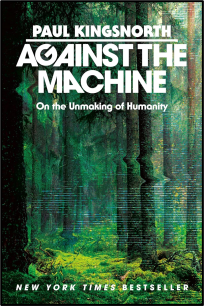
From last week’s Book Portrait Against the Machine by Paul Kingsnorth:
Empathy is an Exploit
Would you rather become the richest man in the world by fully embracing technology or someone choosing to live in the woods on the far edge of technology? This is the tale of two men who could not meet for coffee together without a spat.
Over the past three decades, Elon Musk has staked out a place for himself where the SpaceX IPO made him, for about two weeks in June, the world’s first trillionaire. His political views have shifted over that time from slightly left of center to far right. Muskism: A Guide for the Perplexed by Quinn Slobodian and Ben Tarnoff (2026) explores the ‘Muskism’ philosophy that drives Musk and his fellow cultural activists.
On the opposite side of the spectrum is Orthodox Christian Paul Kingsnorth, a perceptive thinker with a critical view of technology that questions why we sacrifice ourselves to our devices. His book, Against the Machine: On the Unmaking of Humanity (2025), the subject of this month’s Book Portrait, diagnoses all that is wrong with Musk’s approach, and how to resist the pull towards ‘unhumanity’.
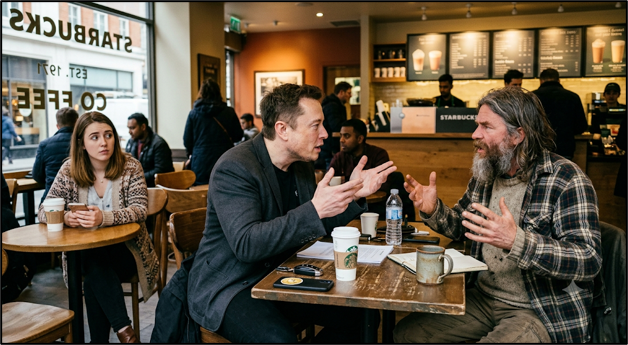
Oddly enough, if we picture the chainsaw-wielding engineer Musk and the anti-Machine hermit Kingsnorth meeting at Starbucks for coffee, both are describing the same system. What they agree on is that the technology is becoming autonomous, the state is being hollowed out, and humans are being rewired.
Muskism’s goal is to “vassalize the government... sovereignty-as-a-service”. Kingsnorth concludes that “the complete negation of all tradition... would lead to rule by the only large institutions still standing: global corporations“. The outcomes in each case confirm each other. One is a plan to subjugate the state, the other is a prediction with a dire warning.
They differ on one principle only. Are humans the point of the system, or will they be discarded like scaffolding from a building site? That single disagreement produces every contrast below. Put yourself at the table next to the debate at Starbucks. Keep score on yourself, not on the ideas of Musk and Kingsnorth.
Empathy
Musk’s “exploit” vs Kingsnorth’s love of neighbour
Elon Musk’s advice to his brother Kimbal was that empathy is not an asset. He saw empathy as a bug in any system, whether personal relationship or government bureaucracy.
“He understood empathy itself in coding terms. It was an ‘exploit’ or a software vulnerability against which the system architecture needed to be hardened.”
In Kingsnorth’s estimate, compassion is a foundational feature.
“...a moral order to society which is based on love of neighbour rather than competition with everyone.”
Musk treats empathy as a vulnerability that allows “enemy” immigrants to infect Western civilization. Kingsnorth welcomes the very same immigrants as neighbors. In one case the system needs inoculation. The other builds a compassionate society.
After Musk ran his DOGE experiment (the slash-and-burn Department of Government Efficiency) through the U.S. government departments in the early days of Trump’s second term, those most affected strongly pushed back. Slobodian and Tarnoff write:
“But society is not a factory. It encompasses children, the elderly, the disabled, the geographically stranded—the very categories of life that markets define as surplus.”
Musk tried to patch the “exploit”, but the people affected literally became the error messages.
The second great commandment is to love your neighbor. But “suicidal empathy”, as Musk names it, is a direct inversion of the Sermon on the Mount, and it’s the language some Christian nationalists and far right podcast hosts now lean on.
Creature or machine
Musk’s “giant cyborg” vs Berry’s great division
Muskism considers the human as no longer central to history but destined to be discarded like scaffolding once construction is complete.
“We are effectively already a human–machine collective symbiote... We’re like a giant cyborg. That’s actually what society is today.”
Kingsnorth sees the world as an organism rather than a mechanism when he quotes Wendell Berry.
“It is easy for me to imagine that the next great division of the world will be between people who wish to live as creatures and people who wish to live as machines.”
Musk doesn’t mince words when he asserts that the merger has already happened, and celebrates the fact.
If society is already a cyborg, then choosing to resist it is longing for a simpler past. Neuralink, Grok and the workerless Gigafactory follow logically if upgrading a cyborg is the only option left. If humans are creatures, every one of those products also removes something essential.
Sovereignty vs roots
Sovereign individual vs rooted creature
Elon Musk and Peter Thiel were co-founders of the company that became PayPal. Thiel’s favorite book was The Sovereign Individual, by Davidson and Rees-Mogg, and he described PayPal as “a new world currency, free from all government control and dilution—the end of monetary sovereignty.” Musk was the man who actually achieved what the book imagined.
Kingsnorth saw this same ongoing mass uprooting as a crisis.
“Rather than seeing humans as hefted creatures, rooted, Weil-like in time and place, this new lens offers a new vision: detached, sovereign personhood.”
Musk’s (and Thiel’s) dream of the sovereign individual is what threatens to cut down Kingsnorth’s “hefted” creature. Both books agree that the result is detachment, but Musk calls it freedom and Kingsnorth calls it homelessness.
As Slobodian and Tarnoff describe it, “Trying to unplug from Musk, you realize he owns the socket.” In the thinking of Kingsnorth, the price for that socket is that millions get uprooted.
The sovereign individual idea, if carried to its logical conclusion, creates exactly one sovereign individual. When Poland’s foreign minister complained to Musk about Starlink reliability, the answer was “Be quiet, small man.”
Greatness
“Law of the universe” vs a definition that excludes Hitler
Thiel treats inequality as a feature of the system. “Severely unequal distributions” are simply the “law of the universe”. “Not everyone can be Einstein and Shakespeare: in business as in life, a select few outpace the rest.” Greatness is scale, and scale is physics.
Kingsnorth answers with Simone Weil, who saw that any definition of greatness built on scale cannot exclude Hitler. The only fit punishment for him, she wrote, is “such a total transformation of the meaning attached to greatness that he should thereby be excluded from it.” Weil would anchor greatness in the eternal things: God, tradition, roots, culture. When Jesus pointed to “the least of these,” he wasn’t measuring scale.
I had never seen the Tesla bumper sticker that says “I bought this before Elon went crazy“ until the day after I read this quote in the Muskism book. If you measure value based on the market you end up with Musks, but obviously not everyone buys into that confusion.
Conclusion
In the end DOGE failed, and the Machine’s own engineers discovered, according to Muskism’s own authors, that the children, the elderly, and the disabled were not “programmable units” or bugs in the system. Musk says empathy is a vulnerability. Kingsnorth says it’s the foundation of humanity.
Your phone and much of modern technology were built by people who agree with Musk. Berry’s division between choosing to live as creatures or machines is a choice you are already making, mostly without noticing, every time you hand a human task to a machine because it’s easier.
This week, name one thing you’ve surrendered to the Machine without deciding to. Make a conscious effort to decide on purpose, either way.
The full book blurb for Muskism: A Guide for the Perplexed will appear in next week’s [Notes] & “Quotes”.
Further related books from my library:
The Hour of the Predator: Encounters with the Autocrats and Tech Billionaires Taking Over the World (da Empoli, 2025)
Describes the effort of the “tech bros” to, in the words of Elon Musk, “vassalize the government”.
More Everything Forever: AI Overlords, Space Empires, and Silicon Valley’s Crusade to Control the Fate of Humanity (Becker, 2025)
A previous Book of the Month, an in-depth look at the Silicon Valley personalities that shape our future.
The Coming Wave: Technology, Power, and the Twenty-First Century’s Greatest Dilemma (Suleyman, 2025)
Addresses the future impact of technology becoming autonomous, paired with the hollowing out of the state.
God, Human, Animal, Machine: Technology, Metaphor, and the Search for Meaning (O’Gieblyn, 2022)
She reaches similar conclusions about the Machine from lost faith rather than found faith.
Religion and the Technological Future: Biohacking, AI, and Transhumanism (Mercer & Trothen, 2021)
Survey of how human-enhancement technologies challenge and reshape religious ideas about what it means to be human, and how major faith traditions respond to the prospect of technologically upgraded people.
Life 3.0: Being Human in the Age of Artificial Intelligence (Tegmark, 2018)
The “giant cyborg” case made positively, a book Musk would have read and liked.
The Axemaker’s Gift: Technology’s Capture and Control of Our Minds and Culture (Burke, 1997)
A previous Book Portrait, this book describes the same “technology captures our minds” diagnosis as Against the Machine, but 30 years earlier.
Thanks for reading this month’s Illuminating Insight!

July’s wrap-up [Notes] and “Quotes” will include the following books, along with others:
Regime Change: Inside the Imperial Presidency of Donald Trump
Haberman, Maggie, Swan, Jonathan (2026, 496 pp.)
The Christian Past That Wasn’t: Debunking the Christian Nationalist Myths That Hijack History
Warren Throckmorton (2026, 319 pp.)
Communion: Finding My Way Back to Faith
J.D. Vance (2026, 304 pp.)
The Hidden Roots of White Supremacy: and the Path to a Shared American Future
Robert P. Jones (2023, 400 pp.)
Everything Happens for a Reason: And Other Lies I’ve Loved
Kate Bowler (2019, 208 pp.)
Joan Didion (2007, 227 pp.)
Muskism: A Guide for the Perplexed
Quinn Slobodian,Ben Tarnoff (2026, 256 pp.)
Hayek’s Bastards: Race, Gold, IQ, and the Capitalism of the Far Right
Quinn Slobodian (2026, 288 pp.)
How to Think About God: A Guide for the 20th-Century Pagan
Mortimer Adler (2008, 190 pp.)
Very interesting.